Ashley Kamal
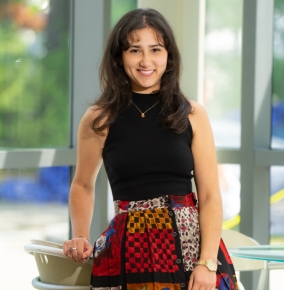
When did you join the Laboratory, and what made you decide to pursue a career here?
During my junior year in undergrad, I was a co-op student in the Lab's Advanced Undersea Systems and Technology Group. I was drawn to the Lab as a place to pursue a career because of the opportunities for technical exploration and mentorship. After graduating in 2022, I became a full-time employee focusing on AI/ML [artificial intelligence and machine learning] algorithm development for the undersea domain.
Coming in with an applied mathematics degree, I had no exposure to acoustics or the ocean, so I first had to get up to speed on the problem space of undersea systems and technology (and all the acronyms!). I began with a project surveying low-SWaP [size, weight, and power] AI algorithms for sonar signature classification. Since then, I've been building my knowledge of undersea mission needs and data types, and various AI/ML methods such as self-supervised and few-shot learning. Now, I feel like a major contributor to finding meaningful solutions to difficult and evolving challenges for the undersea community.
What is the most exciting and/or challenging part of your work?
The underwater domain still has many open questions in areas like navigation, situational awareness, and environmental dynamics. The vastness and diversity of problems make this domain an exciting one to innovate in! When diving below the surface, we can discern a great deal more from listening than we can from "seeing," but underwater acoustic data can be inconsistently noisy with various degrees of predictably because of the dynamic nature of the ocean.
If we want to apply AI/ML in a meaningful way, we need to creatively adapt algorithms and state-of-the-art AI concepts for signals that don’t have the structure or as large a number of examples as available in the internet’s worth of open-source data. Providing our sponsors and technology end users with ways to consistently characterize the environment during undersea missions requires many subject-matter experts, advanced signal processors, and an understanding of the advantages and shortcomings of AI/ML.
Where have you traveled and/or would like to travel?
I love exploring cities by public transportation or by foot on unmarked trails. Chasing new experiences where adventure could lurk around any corner makes me feel like a kid again! I've meandered through Granada's Old Town cobbled streets, marveling at the Moorish architecture; hiked a hidden trail to a natural hot-spring river in Iceland; road-tripped from Barcelona, Spain, to Porto, Portugal, strolling through small seaside towns and large bustling cities; scrambled down a waterfall in Puerto Rico's El Yunque rainforest before salsa-ing the night away; and experienced a blizzard in the Grand Canyon and 90-degree desert sun two days later on an Arizona road trip. Next on the list are hiking along the coast of Sardinia, Italy, and skiing in Japan.
What are your favorite activities?
My free time these days is filled with figure skating, tennis, and roundnet (aka spikeball) — hobbies that I fell in love with after joining the Lab. I enjoy being active, learning new physical skills, pushing through plateaus, and focusing on minute details to become a better athlete. When I'm not physically running around, you'll find me decorating cupcakes or binging novels and modern-philosophy podcasts.