News
Lincoln Laboratory in the News
The following articles were published in external publications and contain news about MIT Lincoln Laboratory efforts.
President Obama Meets U.S. Laureates of 2012 Kavli Prizes
The Kavli Foundation
29 March 2013
President Barack Obama met in the Oval Office yesterday the six U.S. recipients of the 2012 Kavli Prizes. President Obama received the laureates to recognize and honor their landmark contributions to the three fields for which the Prizes are awarded—astrophysics, nanoscience and neuroscience. full story
Among the 2012 recipients is Jane Luu, a technical staff member at MIT Lincoln Laboratory. Dr. Luu was a co-recipient of the prize in astrophysics with David Jewitt and Michael Brown; the prize recognized their discovery and characterization of the Kuiper Belt. See the earlier story on Dr. Luu's award.
Comet in tonight's sky discovered using MIT Lincoln Lab technology
boston.com
12 March 2013
A comet visible in the night sky with a pair of binoculars for much of this month was discovered using technology developed at the MIT Lincoln Laboratory in Lexington. The Pan-STARRS comet this is passing about 100 million miles from Earth could be visible, with clear skies, using binoculars or a small telescope tonight and Wednesday night. full story
MIT Lincoln Laboratory is named Stevens Institute of Technology's 2012 Internship Employer of the Year
MIT Lincoln Laboratory welcomed six Stevens students into its prestigious summer research program.
In recognition of the organization’s special efforts in supporting the Stevens community, MIT Lincoln Laboratory accepted the 2012 Internship Employer of the Year Award from the Stevens Office of Career Development at a special luncheon on Oct. 3, 2012 preceding Stevens Class of 2013 Career Fair.
The real Tron: IT security as a shoot 'em up
NewScientist
4 October 2012
Alert to a sudden threat, you race down a virtual corridor of servers, hot on the tail of malicious software. You ping a message to your partner, pointing them to a bottleneck in the network which should let you pin down the malware and destroy it before it does any more harm. Doing your job has never been so much fun.
This is a long way away from traditional IT security, but the drama of video gaming actually enables analysts to watch over their networks more effectively. Developed at the Lincoln Laboratory, part of the Massachusetts Institute of Technology, the approach allows people to patrol their assigned environments as if they were playing a first-person shooter—much like in the cult film Tron.
Lincoln Laboratory's Next-Generation Incident Command System (NICS) is praised
27 September 2012
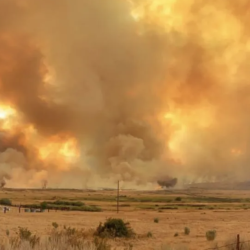
National news outlets have highlighted the successful use of NICS during the recent Shockey fire in southern California.
Coverage by NBC's San Diego affiliate
Coverage by CBS's San Diego affiliate
Coverage by San Diego's CW affiliate
CAMPO – As CAL FIRE nears containment on the 2,851 acre Shockey Fire burning near the community of Campo in San Diego County, firefighters are crediting new technology in the success of the incident. For the past year, firefighters have been aided by the development of a new project called Next Generation Incident Command System, or "NICS." The new technology is funded by the Department of Homeland Security's Science and Technology Directorate and developed by Massachusetts Institute of Technology's (MIT) Lincoln Labs with major participation from CAL FIRE. Especially this year with the increased fire activity, CAL FIRE has been the perfect test bed for the new technology.
Museum of Science honors four New England companies with "Invented Here" awards
Boston Globe
21 September 2012
Boston's Museum of Science held its second annual "Invented Here" awards ceremony last night, in partnership with the Boston Patent Law Association. The event "honors New England's newest and most innovative technologies," according to a press release.
(One of the winning companies, TeraDiode, has licensed technology developed at Lincoln Laboratory for its diode laser system for industrial cutting and welding.)
Infrared eye in the sky aids firefighters
San Diego County News Center
7 August 2012
Even if you go up in a plane, when thick, opaque smoke blankets acres or square miles, it’s nearly impossible to read what the fire’s doing beneath the smoke cover.
But in San Diego County, an experimental system that uses an infrared video camera mounted underneath a firefighting plane has been a keen eye in the sky that peers straight through smoke. The heat sensing camera develops a sharp image of wildfire that shows where flames are growing, spreading, or dying down. A streaming video link and remote control allows fire managers on the ground to point the camera and direct water drops or the overall firefighting effort.
The prototype system installed in 2009 –the first of its kind in the U.S. to be used for civilian firefighting—has has been an experimental program in a partnership between CAL FIRE and the Lincoln Labs at the Massachusetts Institute of Technology.
Air Force Space Command group tours radar sites
U.S. Army News
27 January 2012
U.S. ARMY KWAJALEIN ATOLL, Marshall Islands — The commander for Air Force Space Command got a firsthand look at the radar and GPS facilities on Kwajalein and Roi-Namur during a visit to USAKA Monday and Tuesday.
Gen. William Shelton and several one-star generals from his staff came to Kwajalein to visit facilities and discuss future efforts of cooperation and coordination between the Air Force and Army in the arena of space operations.
"USAKA plays an important role in support of space operations missions," said Col. Joseph Gaines, USAKA/RTS [Reagan Test Site] commander. "Many people think of USAKA as just a test range; however, what we contribute to the space operations mission is quite significant. Having Gen. Shelton come to Kwajalein is recognition of the important role USAKA/RTS plays in the space operations arena."
MIT Lincoln Laboratory currently is the scientific advisor to the Reagan Test Site and has just celebrated its 50th year of service at the Kwajalein Atoll. The Laboratory has been instrumental in the development and operation of the radar facilities.
Obama honors Mildred Dresselhaus with Fermi Award
MIT News
12 January 2012
President Barack Obama has named MIT's Mildred S. Dresselhaus and Stanford University's Burton Richter '52 PhD '56 as winners of the Enrico Fermi Award, one of the government's oldest and most prestigious awards for scientific achievement. The award, administered on behalf of the White House by the U.S. Department of Energy (DOE), carries an honorarium of $50,000, shared equally, and a gold medal.
In a career spanning more than 50 years at MIT and its Lincoln Laboratory, Dresselhaus has made extensive research contributions and fundamental discoveries in condensed matter physics. She is also widely recognized for her considerable devotion to mentoring students, raising community awareness, and promoting progress on gender equity. She is widely respected as a premier mentor and advocate for women in science.
Space Surveillance Telescope to provide enhanced view of deep space
Defense Advanced Research Projects Agency (DARPA)
12 April 2011
Swirling thousands of miles above earth, military satellites provide critical capabilities to warfighters—which makes protecting them from collision with space debris, meteors and microsatellites a top priority. Until now, monitoring the deep regions of space has been difficult, with spots and gaps in coverage leaving these high-flying machines vulnerable. DARPA's newly developed Space Surveillance Telescope (SST) aims to change that, ushering in a new era of ground-based space surveillance technology to fill coverage gaps and offer an unprecedented wide-angle view of small objects in deep space. more ›
Researchers in MIT Lincoln Laboratory's Space Control mission area developed technology, including optics and charge-coupled device technology, that is enabling the SST.
Seeing through walls
MIT News
18 October 2011
Researchers at MIT's Lincoln Lab have developed new radar technology that provides real-time video of what's going on behind solid walls....
The researchers' device is an unassuming array arranged into two rows — eight receiving elements on top, 13 transmitting ones below — and some computing equipment, all mounted onto a movable cart. But it has powerful implications for military operations, especially "urban combat situations," says Gregory Charvat, technical staff at Lincoln Lab and the leader of the project.
Women engineers bring unique perspectives to the workplace
Diversity/Careers in Engineering & Information Technology
Summer/Fall 2011 edition
The focus article of this edition of the online publication profiles a number of women working in diverse science and engineering fields. Among the women featured is Jessica Olszta of the Surveillance Systems Group at MIT Lincoln Laboratory.
The Incident Command System
Firehouse
February 2011 issue
This article explores the benefits and challenges of migrating the Incident Command System to its next level, given remarkable advances in enabling technologies, a changing threat, the importance of thinking about response as all risk (multi-cause/multi-agency/multi-organization), and new concepts of operation. . . .
The article mentions work Lincoln Laboratory is doing on disaster response systems.
Clean, low-energy solutions sought for mammoth program
U.S. Air Force website (29 November 2010)
In October, Electronic Systems Center at Hanscom Air Force Base, Massachusetts, released a Request for Proposal announcement for the Space Fence program, which is expected to deliver a system of geographically dispersed ground-based sensors to provide timely assessment of space events.
In the upcoming design review phase, officials will consider energy options for the large amount of energy required by the huge S-band radars that will track space objects and debris. MIT Lincoln Laboratory is assisting in the development of the Space Fence, and Lincoln Laboratory technical staff who participate on a committee studying alternative energy solutions for Department of Defense needs are involved in the analysis of Space Fence energy requirements.
Winners of ONR's Energy Challenge to help Navy reduce its carbon footprint
Office of Naval Research (26 May 2010)
Aiming to motivate researchers to help the U.S. Navy decrease its reliance on fossil fuels, the Office of Naval Research (ONR) announced nine winners of an "Energy Challenge" that was issued at its recent Naval Energy Forum.
The recipients, whose projects range from microbial to solar power, will receive up to $100,000 to apply toward their research area, said Dr. Rich Carlin, who heads ONR's Sea Warfare and Weapons Department....
Dr. Theodore Bloomstein of MIT Lincoln Laboratory was chosen as one of the challenge winners. His work was on solar cell research.
Major upgrade to Haystack radar will enable enhanced imaging of space
Hanscom Air Force Base Public Affairs (19 May 2010)
In a joint project with Air Force Space Command and MIT Lincoln Laboratory, the Electronic Systems Center began a major upgrade of the Haystack radar in Tyngsborough, Massachusetts, this month, replacing the existing antenna with a new system that will be able to identify smaller objects in space with greater resolution. The approximately 18-month project will add W-band capabilities to the existing X-band long-range imaging radar.
Four Indian students emerge winners at Intel fair
The Hindu Business Line (16 May 2010)
Four Indian students were the recipients of awards at Intel's 2010 International Science and Engineering Fair (ISEF) held in San Jose, California. The ISEF, a program of the Society for Science & the Public (SSP), is the world's largest pre-college science competition....
Since 2002, MIT Lincoln Laboratory has partnered with SSP to encourage students worldwide to explore science and engineering. The Laboratory, in conjunction with the International Astronomical Union, names minor planets in honor of the first- and second-place winners, and their teachers, in three different competitions sponsored by SSP. More than 2500 students and teachers have been honored through this program, called the Ceres Connection.
ISIS: New Video Camera Sees It All
Department of Homeland Security (6 May 2010)
A new video surveillance system currently being developed by the Department of Homeland Security's Science and Technology Directorate (S&T) may soon give law enforcement an extra set of eyes. The Imaging System for Immersive Surveillance (or ISIS) takes new video camera and image-stitching technology and bolts it to a ceiling, mounts it on a roof, or fastens it to a truck-mounted telescoping mast.
Like a bug-eyed fisheye lens, ISIS sees v-e-r-y wide. But that's where the similarity ends. Whereas a typical fisheye lens distorts the image and can only provide limited resolution, video from ISIS is perfectly detailed, edge-to-edge. That's because the video is made from a series of individual cameras stitched into a single, live view—like a high-res video quilt. . . .
Many of the ISIS capabilities were adapted from technology previously developed by MIT's Lincoln Laboratory. . . .
At Logan, new device keeps eye on everything
Boston Globe (3 May 2010)
A prototype camera developed jointly by a team of engineers at MIT Lincoln Laboratory and at the Pacific Northwest National Laboratory in Richland, Wash., has been affixed to the ceiling of Logan International Airport's Terminal A since December. Massport officials say it can do what no other surveillance camera can: blend feeds from multiple cameras into one undistorted image to provide a high-resolution panoramic view, while retaining the ability to zoom in on any spot without losing the 360-degree view.
Boeing launches compact, energy-efficient 3D imaging camera
Gizmag (11 March 2010)
A compact 3D imaging camera launched by Boeing and designed to be deployed on a wide range of platforms, including unmanned aerial and ground vehicles, is equipped with advanced sensors developed by MIT Lincoln Laboratory.
Suspected Asteroid Collision Leaves Trailing Debris
NASA's Hubble Space Telescope has observed a mysterious X-shaped debris pattern and trailing streamers of dust that suggest a head-on collision between two asteroids. . . .
The comet-like object imaged by Hubble, called P/2010 A2, was first discovered by the Lincoln Near-Earth Asteroid Research, or LINEAR, program sky survey on January 6. New Hubble images taken on January 25 and 29 show a complex X-pattern of filamentary structures near the nucleus.
Earth to Get Close Shave Wednesday From Newly Discovered Asteroid
Wired Science (January 2010)
An asteroid 30 to 50 feet across will pass by the Earth at just more than one-third the distance between the Earth and the moon on Wednesday. That's the closest near-Earth object approach currently known between now and the flyby in 2024 of a similar-size object known as 2007 XB23.
The new asteroid, called 2010 AL30, was discovered by the NASA-funded Lincoln Near-Earth Asteroid Research program, and announced Monday by the Minor Planet Center at the Smithsonian Astrophysical Observatory.
Lunar laser ranging: 40 years of high-level science
SPIE Newsroom (December 2009)
Technology developed at Lincoln Laboratory is enabling lunar laser ranging.
Watching and Waiting: The search for dangerous asteroids is about to begin in earnest
The Economist (December 2008)
On December 6th the University of Hawaii will activate a telescope designed specifically to look for dangerous asteroids. It is called PS1, a contraction of Panoramic Survey Telescope & Rapid Response System, and it is the first of four such instruments that will be used to catalogue as many as possible of the 100,000 or so near-Earth asteroids that measure between 140 metres and a kilometre across....
They are able to do so because they are fitted with special digital cameras whose electronics were developed at the Massachusetts Institute of Technology's Lincoln Laboratory.
Snapshots of staff diversity efforts
MIT News (October 2008)
Imagine a workplace where staff value differences, are committed to building a balanced and diverse community, and are focused on making the culture inclusive and welcoming....
Early in his tenure, Director Eric Evans formed a laboratory diversity committee and charged that group with advancing the professional staff and establishing best practices. Bill Kindred, Lincoln Laboratory's diversity and inclusion officer, is hard at work in this arena.
Photonic Frontiers: Combining beams can boost total power
Laser Focus World (July 2008)
Separate laser beams can be combined to increase power by matching their phases to generate a single coherent beam … or by merging beams of different wavelengths. But getting it right is tricky...
Diode-laser arrays have long generated high powers by combining the outputs of many laser stripes. That works well for applications, like diode pumping, that do not require high beam quality. However, combining outputs in that way cannot increase the radiance beyond that of a single laser stripe. "The 'holy grail' of beam combining is to take a bunch of lasers and get a single Gaussian beam out," says T. Y. Fan of the MIT Lincoln Laboratory (Lexington, MA).
NASA selects MIT-led team to develop planet-searching satellite
Space Daily (June 2008)
A planet-searching satellite planned by scientists from MIT, the Harvard-Smithsonian Center for Astrophysics and NASA-Ames is one of six proposed spacecraft concepts that NASA has picked for further study as part of its Small Explorer (SMEX) satellite program. The planet-searching satellite would have the potential to discover hundreds of "super-Earth" planets, ranging from one to two times Earth's diameter, orbiting other stars....
The proposed satellite, called the Transiting Exoplanet Survey Satellite (TESS), would use a set of six wide-angle cameras with large, high-resolution electronic detectors (CCDs) being developed in cooperation with MIT's Lincoln Laboratory, to provide the first-ever spaceborne all-sky survey of transiting planets around the closest and brightest stars.
Googling alien life
Space Daily (March 2008)
MIT scientists are designing a satellite-based observatory that they say could for the first time provide a sensitive survey of the entire sky to search for planets outside the solar system that appear to cross in front of bright stars. The system could rapidly discover hundreds of planets similar to the Earth.
Schoolteachers get a "Lift" at MIT Lincoln Laboratory
MIT News (January 2008)
To encourage high-school students to pursue careers in science, technology, engineering, and math, Lincoln Laboratory hires local teachers every summer to work alongside seasoned scientists. This public, private, and education sector partnership is possible through the Leadership Initiatives for Teaching and Technology Program (LIFT2), and is sponsored by the Massachusetts Department of Education and is funded through the No Child Left Behind Act.
Radar technology fights breast cancer
Science News (November 2007)
In 1990, Dr. Alan J. Fenn, a senior staff member at MIT Lincoln Laboratory, adapted the thermotherapy treatment from a system that used focused microwaves to detect missiles and block out interfering enemy signals.
"It's a very simple idea that can be applied to the treatment of many different cancers, including breast cancer," Fenn said.
top of page