


Waveform for protected tactical satellite communication achieves several firsts
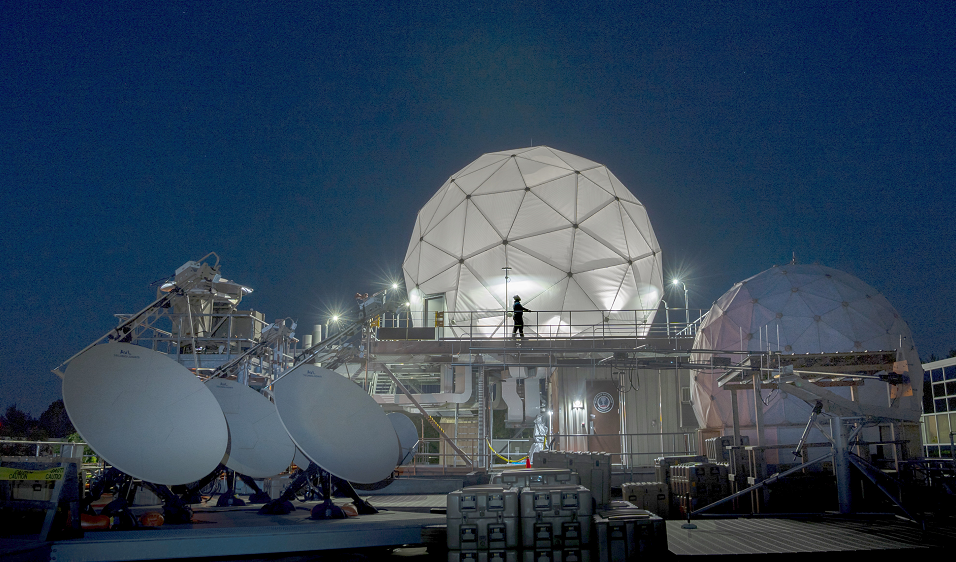
Designed to provide robust, secure, and anti-jam satellite communications (SATCOM) worldwide, the Protected Tactical Waveform (PTW) will allow warfighters to stay connected under the most challenging operational conditions.
In summer 2025, the U.S. Space Force's Space System Command (SSC) demonstrated key capabilities of PTW SATCOM with joint warfighters. For the demonstration, MIT Lincoln Laboratory partnered with industry and other federally funded research and development centers to integrate PTW capabilities on a Joint Hub within the Protected Tactical Enterprise Service (PTES), which is providing the ground infrastructure for PTW use across the U.S. military services.
The test event leveraged the latest versions of industry subsystems within the PTES program, managed by the Space Force's Satellite Communications and Positioning, Navigation, and Timing (SCPNT) Portfolio Acquisition Executive (PAE). The PTES ground infrastructure integrates Joint Hubs and management systems, including the Key Management System, the prototype for which was recognized with a 2025 R&D 100 Award shared between SSC and Lincoln Laboratory. Initially, PTW will be used over the Wideband Global SATCOM system, an established constellation of U.S. military satellites; then, PTW will be extended for use over commercial SATCOM satellites, future U.S. military SATCOM constellations, and eventually SATCOM constellations operated by international partners.
"This demonstration highlights the importance of early integration of complex systems to make critical technologies available sooner to the joint force," says Tactical SATCOM Group technical staff member Nancy List, who led a team of Laboratory staff for the demonstration. "Federally funded research and development centers play a vital role in bridging the gap between cutting-edge research and operational capability. Our expertise in system integration and our deep understanding of the technology involved were instrumental in showing that PTW could perform reliably in contested environments and satisfy warfighter needs today."
Several firsts were achieved during the 2025 demonstration, including
- Frequency hopping (spreading signals over rapidly changing frequencies) at variable interference levels
- Over-the-air operations via five PTW-enabled terminals
- A secure Voice over Internet Protocol (VoIP) call
- A ground bounce from one constellation to another using the PTES Joint Hub
The team will continue to work with the joint force community to scope PTES participation in future demonstrations and exercises.
"This demonstration culminates years of industry and government partnership to realize a modern, anti-jam, low-probability-of-intercept waveform that will underpin future tactical SATCOM operations," says Erin Carper, former senior program director for the PTW Family of Systems at SSC and now the acting SCPNT PAE. "Adversaries and allies understand the criticality of SATCOM on the modern battlefield, and the threats to SATCOM have evolved accordingly. The PTES program will ensure that U.S. and allied warfighters can operate through these threats."
The nascent operational use of PTES will be a milestone in the U.S. Department of War's roadmap for tactical SATCOM services. This roadmap included early PTW prototyping and demonstrations by the Laboratory, starting with the U.S. Air Force's initiative to prototype core elements of a protected tactical SATCOM system. Those early efforts evolved into a family of PTW-based space and ground systems, including PTES, currently in development by the Space Force, and PTW terminals in development by the Army, Navy, and Air Force. In support of early PTW prototyping and testing efforts, the Laboratory built the Multi-Band Test Terminal (MBTT), an asset for industry and government partners to test PTW-enabled terminals and hubs. The MBTT has supported various experiments, including testing of PTW prototype terminals over commercial and Wideband Global SATCOM satellites for the Protected Tactical Service Field Demonstration from 2015 to 2020, and the first over-the-air transmission of PTW using PTES equipment in 2021.
"PTES and PTW are foundational to meet our nation's need for protected tactical SATCOM. We look forward to working with our government and industry partners to accelerate delivery of this capability," says David Browne, an assistant leader of the Laboratory's Tactical SATCOM Group.
Inquiries: contact Ariana Gaines.
Related Links
- Space System Command Proves PTW SATCOM Capability for Warfighters to Operate More Effectively in Contested Environments
- Antenna enables advanced satellite communications testing
- Implementation and Testing of the Protected Tactical Waveform (PTW)
- SSC, Boeing demonstrate successful Protected Tactical Waveform test at MIT's Lincoln Laboratory
- Space Systems Command Demonstrates Satellite Anti-Jam Capability
- Lincoln Laboratory technologies win seven R&D 100 Awards for 2025