


Advancing 6G Communications by Mitigating Interference
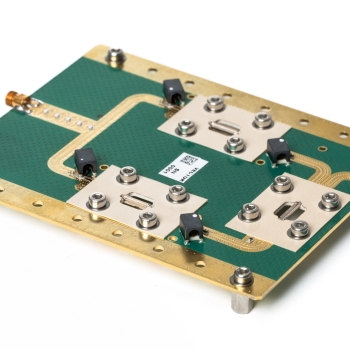
Researchers at Lincoln Laboratory are developing a novel vector modulator to address a challenge that limits the effectiveness of cellular base stations using high-power, full-duplex systems: canceling the self-interference inherent in their simultaneous transmit and receive operation. Base stations that serve expanding mobile-device usage will need robust self-interference mitigation to accommodate the coming high-power, wide-bandwidth, sixth-generation (6G) wireless technology. This new modulator has demonstrated the ability to enable in-band, full-duplex (IBFD) for both high-power and wideband radio-frequency systems.
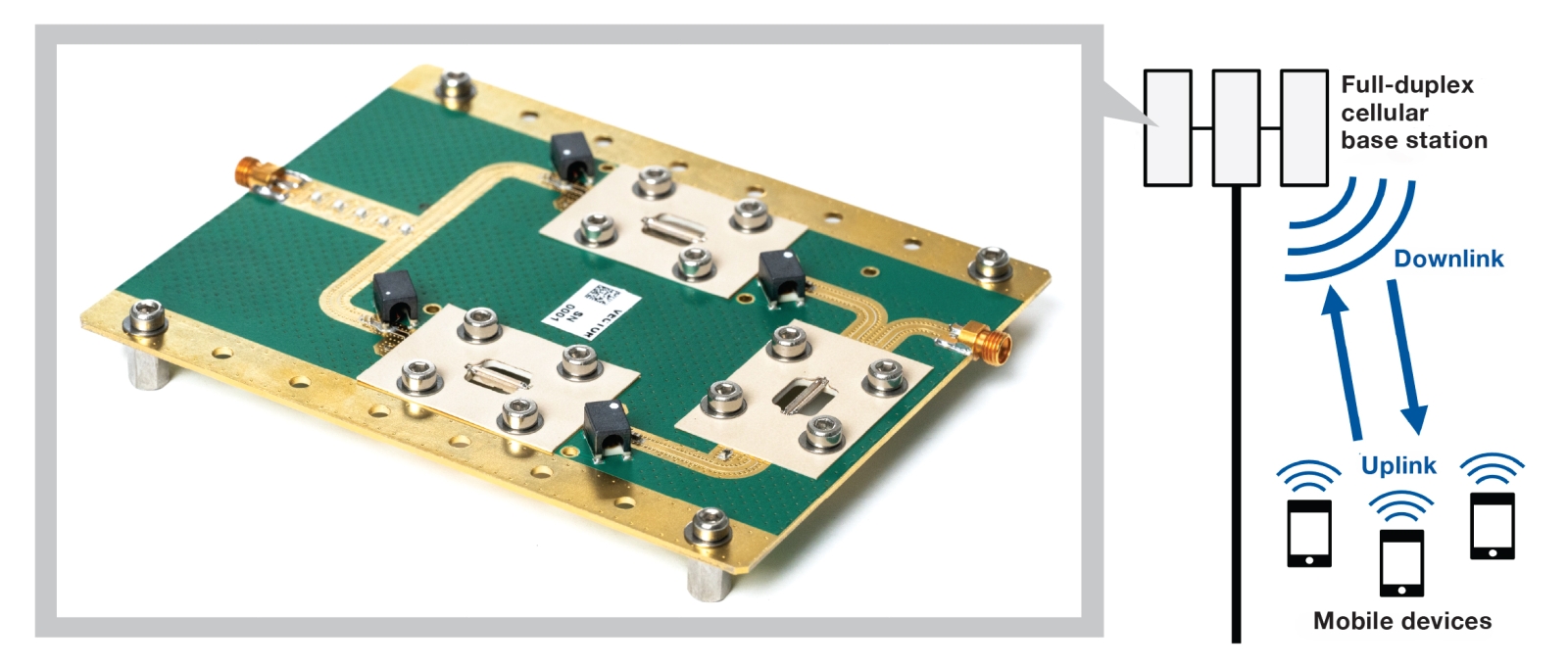
The vector modulator board above is designed to mitigate self-interference generated by high-power, full-duplex 6G base stations servicing multiple mobile devices.
Motivation
Expanding demand for mobile wireless communications will require radio-frequency (RF) systems able to more rapidly process greater amounts of data, use the spectrum more efficiently, and accommodate an increasing number of users. In-band, full-duplex technology that enables RF systems to simultaneously send and receive signals on the same frequencies has been the solution for expanding the amount and speed of data transmission. Base stations routing all this mobile wireless communication face unique challenges when their high-power (>100 W) downlink transmitters, co-located with sensitive receivers listening for low-power uplinks, create direct-path self-interference strong enough to overwhelm the receivers’ ability to process data.
Innovation
Currently, IBFD systems can take advantage of either cancelers that enable IBFD transmissions at high frequencies (up to 1 gigahertz) or those that accommodate high-power transmissions. But they do not have the option of a canceler capable
of covering a wide frequency range and high transmit powers simultaneously—features relevant to cellular base stations, particularly as the demand grows for increased data processing and transmission speed. The novel vector modulator design developed by researchers at Lincoln Laboratory addresses this capability gap.
This modulator utilizes signal reflections through hybrid couplers and PIN diodes to control the amplitude and phase of the cancellation signals to effectively null direct-path self-interference. The modulator also promotes wideband performance, desired for expanded use of the frequency spectrum. Over-the-air demonstrations in an RF anechoic chamber showed that a prototype of the modulator successfully isolated signals from self-interference even when antennas were closely spaced and transmitting high output power.
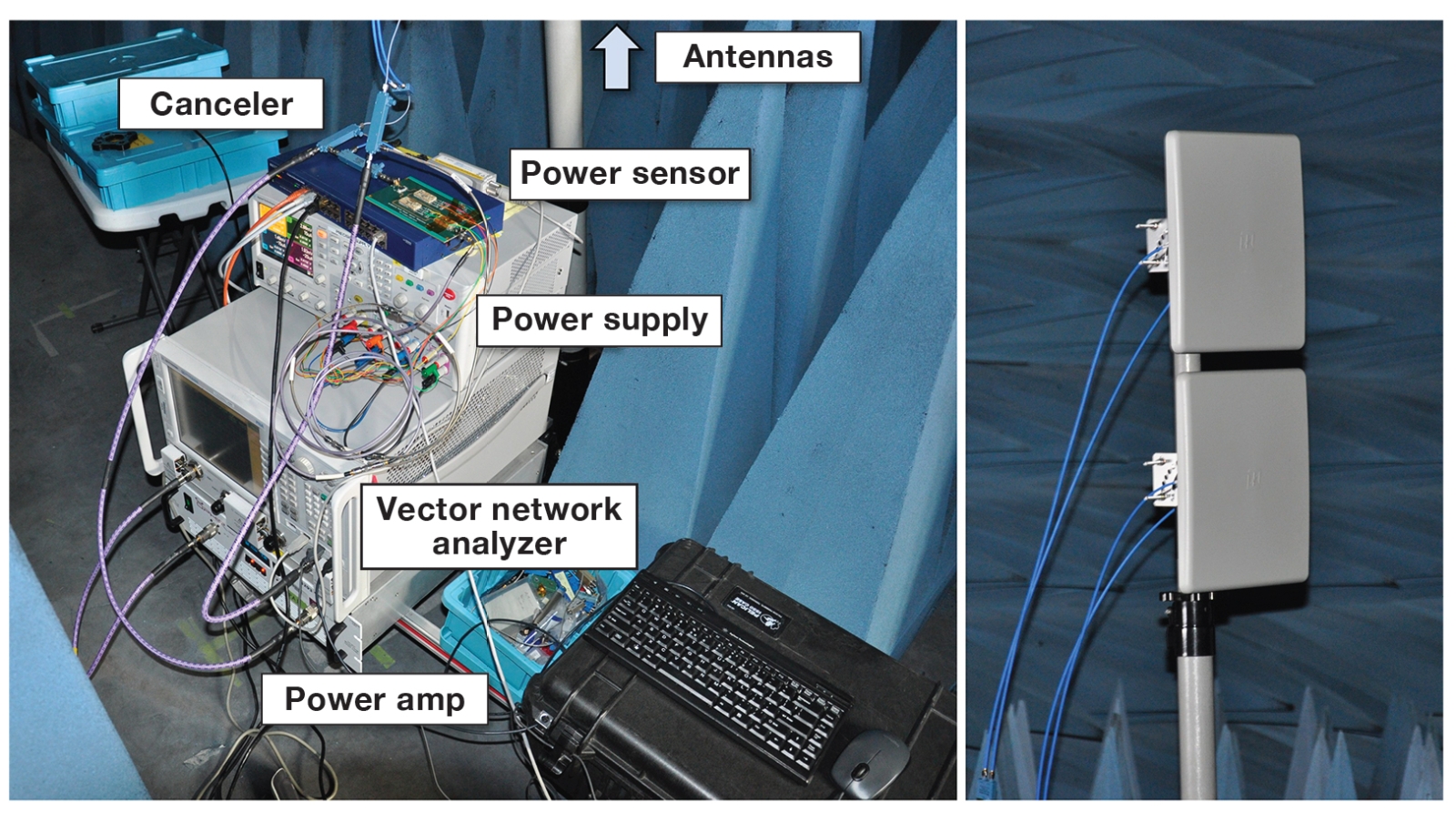
At left is the setup for the over-the-air cancellation measurements in RF anechoic chamber; at right is the antenna array used in the demonstrations.
Benefits
- Leverages a custom 2–18 GHz quadrature hybrid coupler integrated on a printed circuit board to allow incorporation of multiple canceler taps (circuits that annul signal interference) for a full IBFD system
- Utilizes PIN diode-controlled reflections to enable wideband modulation at high input power and with minimal signal loss
- Offers a low-cost, compact design, consisting of diodes and couplers, that does not significantly increase power consumption
Additional Resources
W. Vu and K. Kolodziej, “High-Power Vector Modulator for Enabling Full-Duplex on 6G Base Stations,” IEEE Microwave and Wireless Technology Letters, May 2026.