


Advancing Development of On-Chip Laser Systems
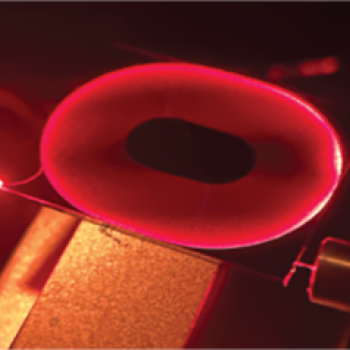
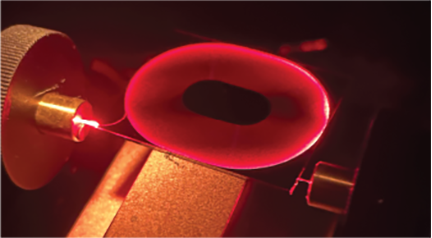
Researchers at MIT Lincoln Laboratory have developed a new architecture for a photonically integrated laser system that uses an interferometer instead of a resonant cavity to stabilize a laser's fluctuations against frequency noise and drift. This interferometric laser, which has demonstrated performance comparable to that of cavity-stabilized lasers, has the potential to advance the state-of-the-art for on-chip lasers, enabling future applications requiring scalability, portability, mass-manufacturability, and robustness.
Motivation
Optical systems have become crucial to fields such as telecommunications, computing, medical imaging, and defense applications because photons (light) are capable of reliably carrying great amounts of information at exceptionally high speeds and low loss. The increasing miniaturization of devices has accelerated the demand for smaller, lower-cost, yet high-performing optical systems embedded in military equipment (e.g., drones, portable communication tools), industrial processes (e.g., automated manufacturing machines), and communication systems (smartwatches, space-Earth satellite transmissions). Photonic integration, the incorporation of multiple optical components such as waveguides and amplifiers onto a single chip, may propel the miniaturization of complex high-performance optical systems.
Innovative Photonic Integration Approach
Currently, cavity-stabilized lasers—often incorporated in systems used for precision metrology, quantum computing, high-resolution sensors, and advanced atomic clocks—have no direct parallel on chip. Lasers stabilized by photonically integrated resonators experience high levels of frequency noise and drift. A research team at Lincoln Laboratory explored replacing the integrated resonators with an interferometer to avoid the disadvantages inherent to resonant structures.
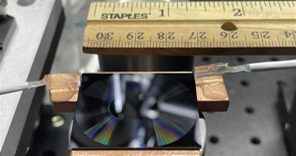
The team's interferometer has two integrated parallel waveguide paths, one of which uses a long delay line (mechanism to control the timing of the light waves). Unlike other fiber interferometric lasers, their laser takes advantage of a spiral design that enables 25 meters of path length to be incorporated within a 2.6 × 3.2 cm integrated chip. By locking a seed laser to the spiral interferometer, the Laboratory team has set a new record for the stability achieved by an integrated laser.
Benefits
- Provides for integration with other system components on chip
- Reduces its long-term frequency drift by an order of magnitude compared to other photonically integrated systems
- Avoids the use of resonant components (e.g., mirrors, switches), enabling a simpler design that supports improved stability, spiraled waveguide length, and cost of manufacture
Additional Resources
W. Loh, et. al., "An Integrated Ultralow Noise Spiral Interferometric Laser," February 18, 2026, arXiv:2602.16461