


Improving the Performance and Scalability of Digital Arrays
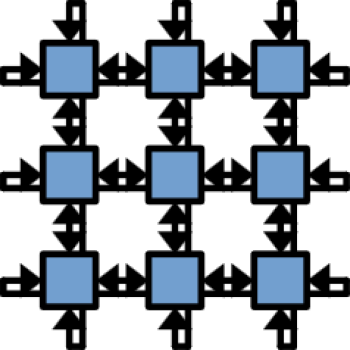
Researchers at Lincoln Laboratory are developing a novel method for processing data acquired via digital antenna arrays. The concept, which addresses a bottleneck in moving data from the array components to centralized data processing, proposes a shift to distributive processing in the backend grid of the array. This approach is designed to alleviate the slowdown and information loss occurring as massive amounts of data produced by digital arrays swamp the traditional architecture for aggregating and then offloading data to a central processor.
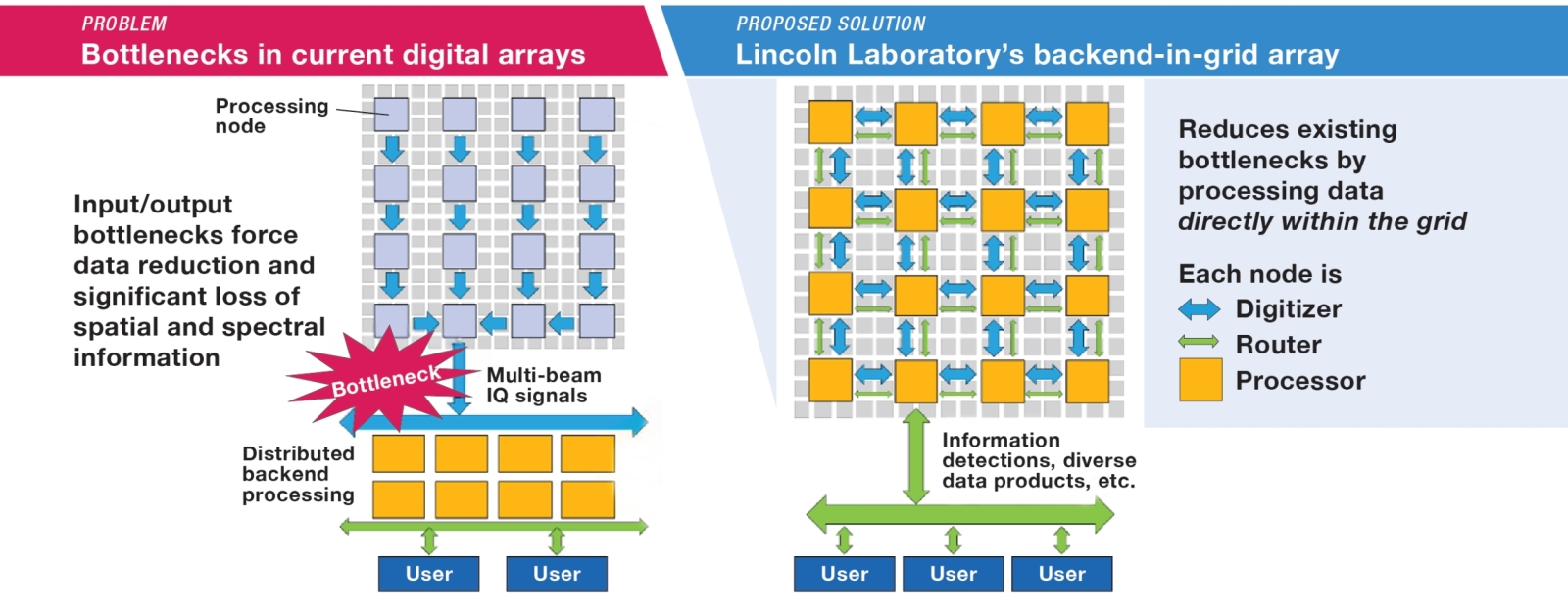
The left-hand illustration depicts the problem of moving data from a digital array to processing, and the right-hand illustration shows the new approach that has data aggregation, conversion, and processing done in the backend of the array.
Motivation
Digital antenna arrays can produce multiple simultaneous beams in arbitrary directions and can apply adaptive processing to mitigate undesired signal interference and clutter in complex or contested environments. These capabilities have made digital arrays desirable for enabling a wide range of applications in military and weather radar, communications, and remote sensing. However, with their ever-increasing numbers of elements (even into the thousands) and expanding bandwidth use, digital arrays collect massive amounts of data that overwhelm traditional processing architectures. The results are diminished computational speed, delayed transmittal of information, and loss of data at bottlenecks in offloading data to central processors.
Currently, researchers are looking to an approach called Scalable On-Array Processing (SOAP) to counter the disadvantages of conventional array processing based on analog techniques. Various solutions are being investigated to reduce the computational load and to integrate processing on the array.
Backend in Grid for SOAP
Researchers at Lincoln Laboratory are exploring a processing architecture that will enable data digitization, routing, and computation at individual array nodes. They are proposing local (backend), structured arrangements for moving data across nodes. The architecture is designed to support the simultaneous processing of data from hundreds of beams while preserving full array degrees of freedom (i.e., wide beam directionality), a necessity for effective nulling of interference. Current work is on demonstrating the distributed processing algorithms on a custom test bed.
The backend in grid approach is aimed at allowing data throughput to scale with array size to alleviate the loss of information encountered when array sizes grow beyond the input/output capacity of a system reliant on moving data to centralized processing. This approach could significantly improve a digital array’s ability to continuously provide up-to-date observations of a wide field of view, giving users more opportunity to detect and respond to situations such as signal disruptions or incoming aerial objects.
Benefits
- Leverages distributed data movement schemes to achieve extremely high beam-bandwidth product (a measure of the number of beams and bandwidths supported) throughput using traditional interconnects available on existing commercial off-the-shelf systems
- Enables greater possibilities for small platforms by reducing or eliminating the need for external processing hardware
- Potentially accommodates dense simultaneous beams over a wide field of view while enabling multifunctionality for converged radio-frequency (RF) apertures
Additional Resources
J. Doane and S. Teal, “Data Distribution for Scalable on-Array Processing,” in 2024 IEEE International Symposium on Antennas and Propagation and INC/USNC‐URSI Radio Science Meeting, posted September 30, 2024.