


Improving Robotic Confined-Space Searches
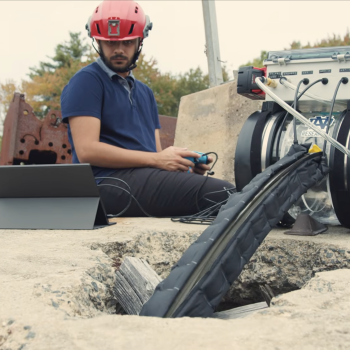
An innovative design for the “nosetip” of a vine robot improves the robot’s ability to navigate its critical tip-mounted sensors, such as cameras and microphones, into cavities within cluttered or collapsed environments. The robot’s flexible vine grows as it delves deeper into a maze of obstacles, but rapid deployment into crucial destinations can be hampered by friction from continual eversion (i.e., an inside-out unfurling) of the vine weighted with sensors at the tip. The new tip dissipates the resistance caused by this eversion, enabling users to inspect complicated sites at speeds required by urgent situations.
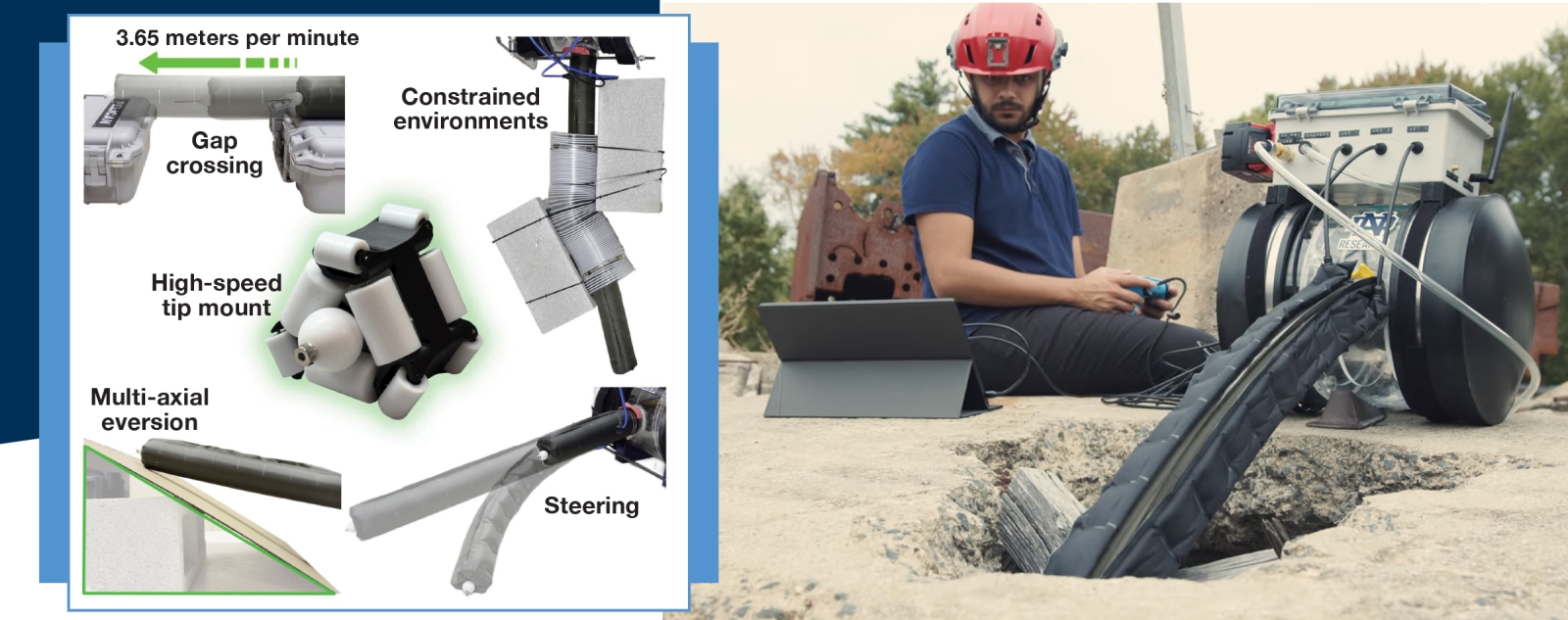
At right, an operator deploys a vine robot into an obstructed fissure to assess the environment. The innovative tip mount (center left) is designed to enable the robot’s vine to expand quickly, even across gaps, and to flexibly steer into confined spaces.
Motivation
Robots valuably partner with humans to explore dangerous environments because they exempt humans from entering perilous spaces. In collapsed structures or obstructed landscapes, vine robots equipped with sensors, such as cameras or radars, could be particularly useful in enabling responders to peer under rubble and into crevices. However, the mechanical action allowing the robot’s vine to grow and maneuver into tight places could be hampered by friction from the expansion of the vine, typically made of a polyurethane-coated or silicon-coated fabric. A smoother vine extension would mean a faster deployment of vital sensors into time-critical situations like search-and-rescue operations.
Innovative Solution
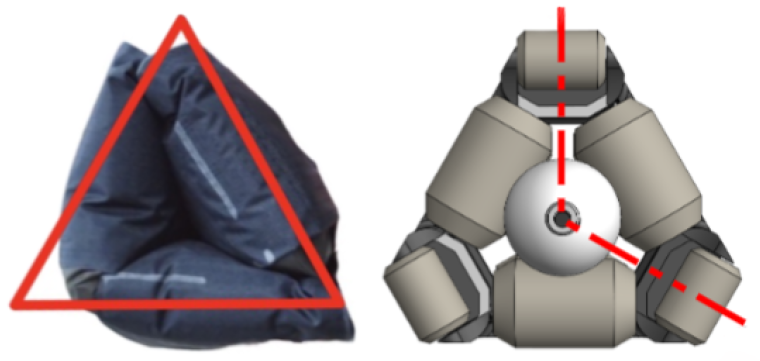
Researchers from Lincoln Laboratory and the University of Notre Dame developed a tip design that takes into account the geometry of the vine as it expands. As the vine extends, it continually folds and unfolds back on itself in a movement known as eversion. The team observed how eversion folds the fabric vine into a triangular shape as it moves outward from the robot.
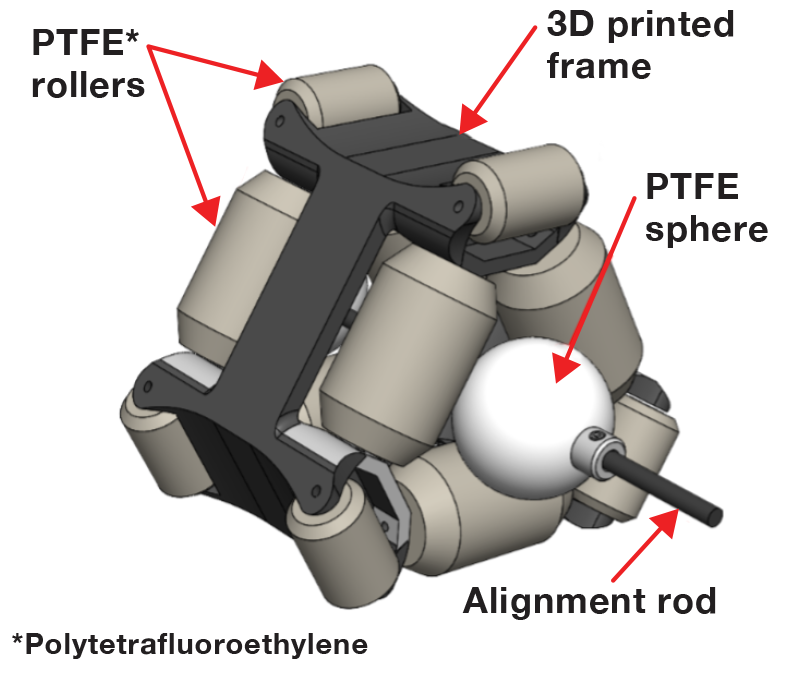
Most vine robots have a tip mount that accommodates the vine’s expansion through a circular opening, but this design constricts the flow of the folding fabric. The new tip mount uses a triangular set of rollers to match the mount geometry to the robot’s natural deformation, thereby minimizing internal resistance, improving consistency during growth, and facilitating high-speed extension over long distances.
Experiments comparing tip-mount designs demonstrated that previously designed circular geometries work against the vine’s triangular eversion, causing uneven pressure distribution and localized fabric constriction. In contrast, the novel triangular mount conforming more closely to the inflating vine shape provides smoother, consistent growth and less tension loss.
Benefits
- Lessens resistance by leveraging the inherent folding geometry of a vine as it lengthens via eversion
- Utilizes lightweight components to minimize adding weight that may hinder the eversion of the vine or the stability of the robot
- After validated performance with a custom-built test bed, serves as a benchmark for future mount designs
Additional Resources
A.A. Valdivia et. al., “Gotta Grow Fast: Design and Benchmarking of a Tip Mount for High-Speed Vine Robots,” IEEE Robotics and Automation Letters, vol. 11, no. 8, August 2026.
C. McFarland et al., “Field Insights for Portable Vine Robots in Urban Search and Rescue,” in 2024 IEEE International Symposium on Safety Security Rescue Robotics, December 2024.
Video: How a Flexible Robot Helps Find Survivors Inside Collapsed Buildings