


Robust Laser Communications at Low Size, Weight, Cost, and Complexity
Lincoln Laboratory’s innovative optical receiver has the potential to expand the use of laser communications (lasercom). This proposed ground terminal will feature low size, weight, power consumption, and cost (SWaP-C) while achieving performance robust enough for most lasercom needs. It’s envisioned to be easier to operate than existing terminals that employ expensive adaptive optics to compensate for light distortion caused by atmospheric turbulence. The proposed terminal could effectively address the growing government and civilian demand for wider access to highly capable lasercom.
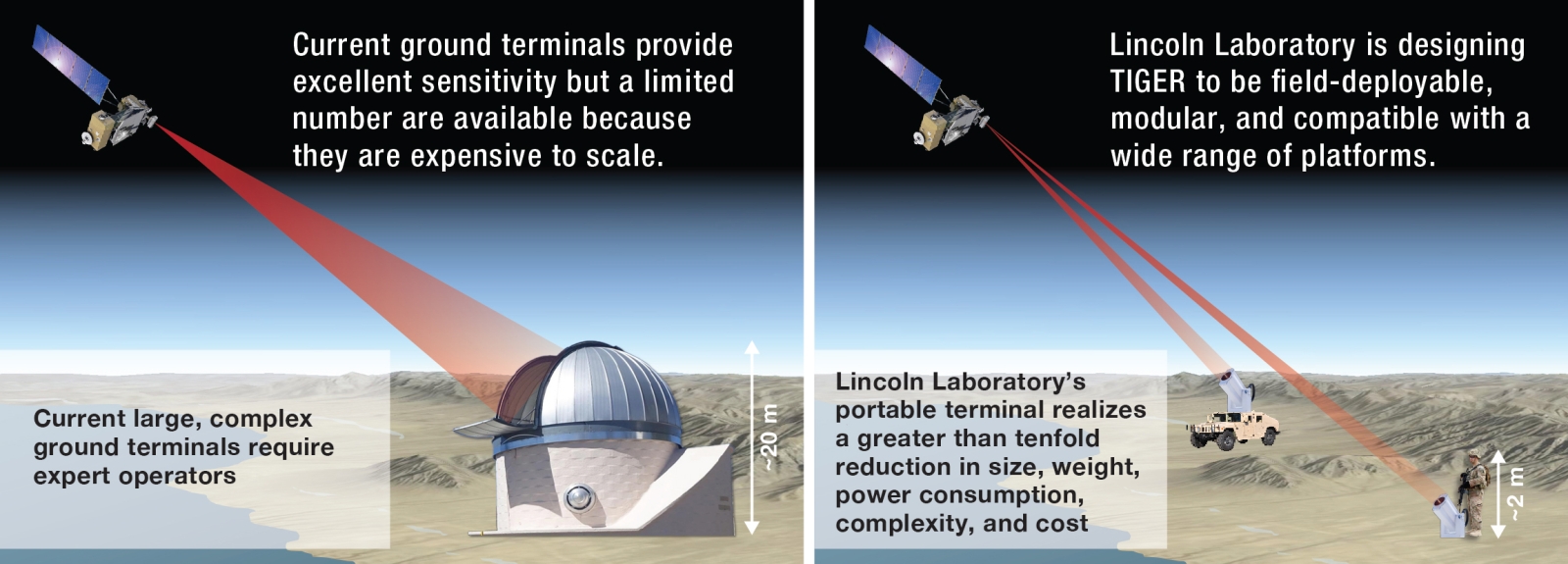
The ease of building, deploying, and using the Laboratory’s proposed Tactical Infrared Good Enough Receiver (TIGER) ground terminal could enable the interconnection of multiple sources, enhancing communication continuity.
Motivation
Defense, commercial, and scientific sectors are increasingly demanding high-speed, high-throughput data transmission from space-based platforms. Lasercom, proven to provide such transmission, has not been widely adopted for space-ground links because current ground terminals rely on architectures built around single-mode fiber receivers that use adaptive optics to mitigate turbulence. These terminals feature exquisite sensitivity and precision, but their scalability has constrained their proliferation.
A terminal that could be fielded rapidly, provide sufficient data transmission, operate under degraded conditions, and be scalable to varying platforms may be seen as an alternative to legacy terminals. Some users may see a less costly terminal with correspondingly less sensitivity as an interesting solution to the accessibility need.
Innovative Solution
Lincoln Laboratory researchers are seeking to develop a ground terminal that would facilitate widespread lasercom ground infrastructure. They envisioned a terminal whose architecture is built from commercial off-the-shelf components and can be scaled and reconfigured to match various needs. The result is a simplified system, nicknamed TIGER for Tactical Infrared Good Enough Receiver. TIGER features a modular, low-SWaP-C architecture designed to achieve “good enough” performance without relying on adaptive optics or active coherent combining techniques. The design supports multiple waveforms and is adaptable to various Earth orbits.
Future Steps
The research team is conducting benchtop testing on the system’s capabilities, performance, and resiliency. Future plans are for a prototype of the receiver to be demonstrated in a simulated environment.
Benefits
- Assembled from fiber-coupled, commercial off-the-shelf components
- Designed to adapt for a range of platforms, e.g., ground vehicles, drones, and ships
- Employs a modular architecture scalable from low to high data rates depending on link conditions
- Requires minimal setup and calibration time, i.e., minutes vs days
Additional Resources
R. Garner et al., “Characterizing a Few-Mode Tracking Receiver for Free-Space Optical Communications,” Proceedings of SPIE LASE, vol. 13885, March 5, 2026