


Antenna array could provide protected tactical satellite communications in low Earth orbit
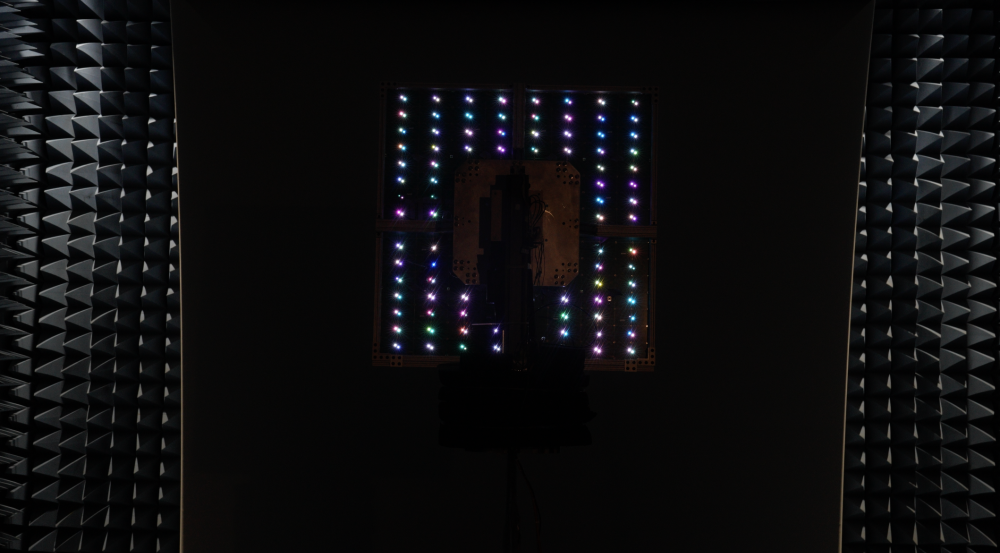
Preventing adversaries from interfering with communications is crucial to national security. Tactical satellite communications (SATCOM) focus on securing reliable communications channels against adversaries in contested environments. In support of this mission, a team from MIT Lincoln Laboratory is building a prototype antenna characterized by low size, weight, power, and cost (SWaP-C).
Threats in contested environments — specifically proliferated low Earth orbit (pLEO), where satellites must be as low-SWaP as possible because of the high volume of satellites present — are signal jamming and signals intelligence. Mitigating these threats through methods such as changing the shape of antenna beams in real time so that the ground user's signals can't be interfered with and preparing for future advanced capabilities are key to ensuring that satellites stay in communication with users on the ground.
"Looking toward the future challenges of tactical SATCOM, there is a clear need for novel approaches to radio-frequency (RF) aperture designs that are scalable and low SWaP-C without sacrificing functionality," says Michael Craton, a technical staff member in Lincoln Laboratory's Tactical Satellite Communications Group. "That is, we want to think about ways we can achieve exquisite performance using less expensive hardware. We want to anticipate future threats and have an idea about how to deal with them before they become a problem."
One way to tackle the challenge of proliferated interference and jamming is through adaptive antenna arrays. Unlike single-element antennas, arrays are made up of multiple antennas that work together to guide and shape energy to and from the array. Adaptive arrays can change beam states quickly (a technique called adaptive beamforming) and change them in real time, depending on conditions, to prevent interference in certain directions by placing nulls, or signals that interfere with others. However, adaptive arrays have high SWaP, making them difficult to operate in SWaP-constrained environments like pLEO.
To address this problem, the team developed the Hosted Nimble Beamforming Anti-Jam Reflectarray (HoNi BAJR), a scanning reflectarray antenna prototype with a surface made up of reflective elements that can be individually controlled. When a signal hits the surface of the reflectarray, individual elements reflect energy with some phase shift to control the beam that is formed so that it blocks interference. Because the elements are very simple, the array can be scaled and controlled easily. Reflectarrays are similar to phased arrays, which consist of multiple elements that can be electronically controlled for quick beam changes, but scanning reflectarrays reflect signals toward a separate feed antenna, which eliminates much of the design complexity in conventional antenna arrays.
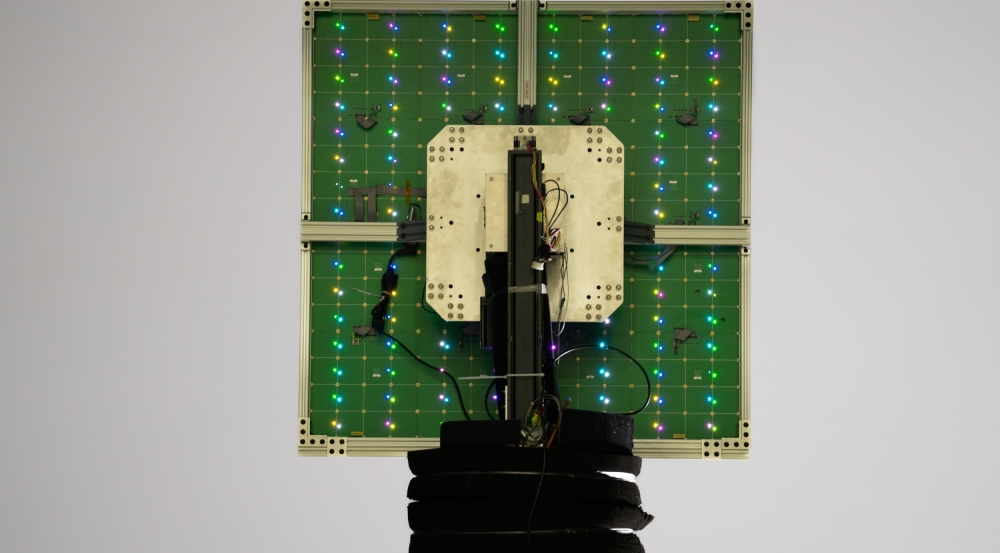
Unlike phased arrays that require amplifiers for each antenna element, reflectarrays do not require amplifiers because signals are collected by the feed antenna and combined in free space; this lack of amplifiers for each element in the reflectarray lowers the SWaP required and helps with scalability, as the beamforming network does not have to be redesigned each time the size of the array is changed. A reflectarray uses much less power than a typical array, dropping the power consumption by about 95%.
The prototype HoNi BAJR reflectarray was designed for communications in a pLEO constellation with wide coverage across the horizon and can cater to low-power users in the presence of proliferated jamming. The array is sized to fit on a typical small satellite platform.
The HoNi BAJR team tested the array's beamforming capabilities at the Laboratory's RF Systems Testing Facility, successfully demonstrating a high scan angle, which means the array can receive signals from a wide area. Their testing also showed that there is little loss in signal when synthesizing multipeak beams, or splitting the beam, indicating that reflectarrays can get signals to multiple users without information loss.
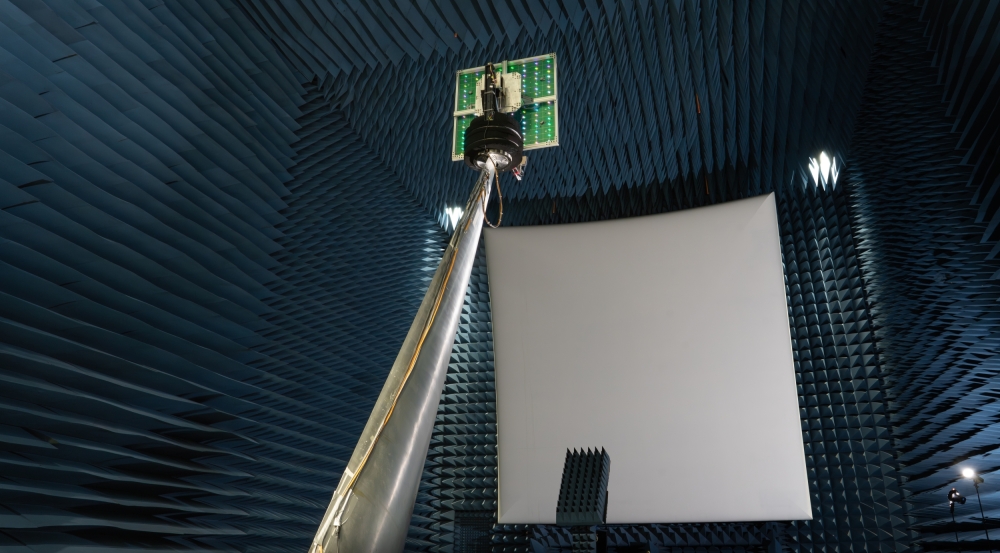
Suppressing interference (unwanted signals from equipment like cell phone towers or electrical devices) is also very important to ensuring the antenna works correctly. The HoNi BAJR team's work in this area is based on two programs funded through an internally administered R&D portfolio: Deployable Electronically Scanning Reflectarray (DESRa) and Phase Analog Beamforming (PhAB, which uses DESRa hardware). PhAB demonstrated that it was possible to adapt to nulls and mitigate signal jamming in real time. However, in the dynamic signal environment of HoNi BAJR, there may not be time to adapt these beams fast enough for the signal environment. The team innovated a solution: creating regions of interference suppression instead of targeting individual points of interferences by shaping the side lobes of the beam. The technique faltered slightly in testing because of difficulty in controlling the side lobes, as they're sensitive to small signal changes. However, proper calibration (measuring effects from the instruments and the system to ensure the full signal received and transmitted by the antenna is accounted for) may help.
While key to ensuring a system works correctly, calibration is one of the biggest challenges of operating reflectarrays. Not much precedence exists for calibrating a scanning reflectarray, so the team is researching approaches. All aspects of the reflectarray (e.g., forming and shaping beams) will be improved by calibration, and full usage of the array will require a comprehensive understanding of calibration. Another major area the team is exploring is where reflectarrays can best be used.
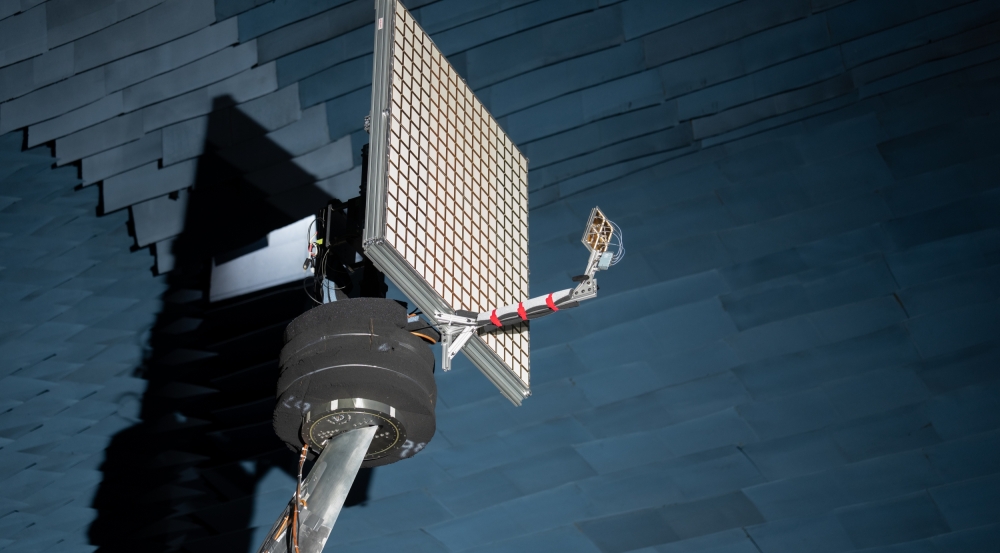
"Designing hardware is always a challenge, but figuring out how to fit the technology into a complete and functional system that meets mission needs is the hardest part," Craton says. "We believe scanning reflectarrays have a lot of untapped potential for the missions we care about, but because they have not been used in this space before, a lot of gaps in functionality remain. We need to first build up capabilities for the things that we need to do."
Early studies show that reflectarrays can be used in situations where beams are scheduled, where there is proliferated interference in less dynamic signal environments (or dynamic signal environments if you can achieve good calibration), and on power-constrained platforms. Future work will focus on further exploring how reflectarrays can be used, improving calibration procedures, and refining beamforming capabilities.
Inquiries: contact Ariana Gaines.
Related Links