


Artemis II live-streams hi-def videos and images from the Moon to Earth

This April, humanity had front-row seats to space as the Artemis II Orion spacecraft transmitted crystal-clear footage of its historic journey around the Moon over more than 250,000 miles back to Earth at speeds on par with those of home internet connections. The live-streaming of high-definition videos and high-resolution photos of the Moon and Earth was made possible through the Orion Artemis II Optical Communications System (O2O).
Toward a high-speed internet in space
Developed by MIT Lincoln Laboratory in collaboration with NASA Goddard Space Flight Center, the onboard O2O payload was the space end of a high-speed laser communications (lasercom) link. This link reached Earth when Orion had a line of sight with primary optical ground stations located at NASA’s White Sands Test Facility in New Mexico and Caltech/NASA Jet Propulsion Laboratory’s Table Mountain Facility in California or an experimental ground station at Australian National University’s Mount Stromlo Observatory. Together with terrestrial networks, O2O formed an internet backbone between the Artemis II Orion spacecraft and the Mission Control Center at NASA's Johnson Space Center in Texas.
"Our goal was to demonstrate O2O's operational utility for human spaceflight, extending the high-bandwidth connections that internet users enjoy on Earth to astronauts in deep space," says lead systems engineer Farzana Khatri, a senior staff member in Lincoln Laboratory's Optical and Quantum Communications Group. "We not only demonstrated the first use of lasercom on a crewed mission beyond low Earth orbit [LEO] but also attracted massive public engagement as the astronauts shared multimedia from their journey in near real time."
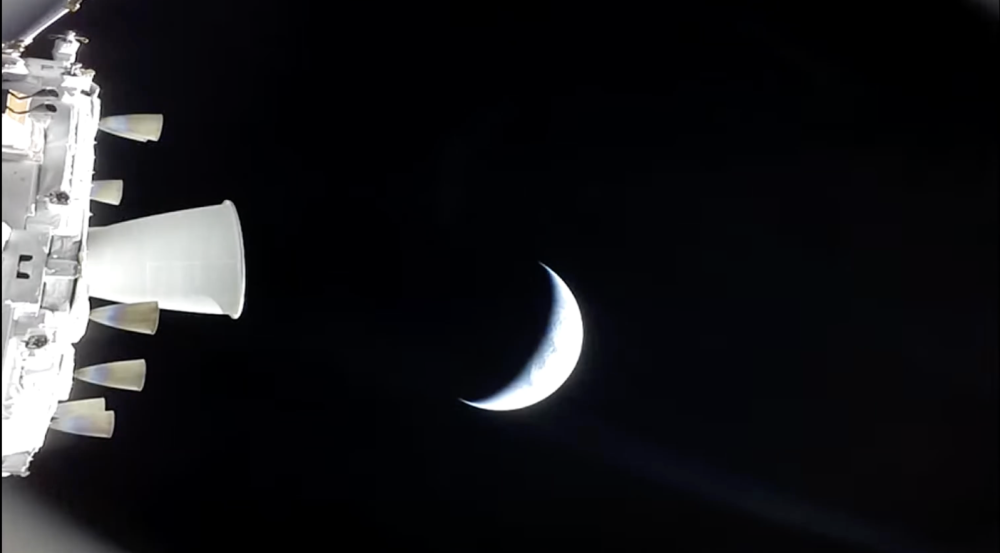
During the last missions to the Moon in the late 1960s and early 1970s, astronauts relied on radio-frequency systems to communicate. But radio waves can only carry so much data per second because of their low carrier frequency; the grainy, poor-quality video and images of the Moon from that time speak to this limited bandwidth. With its much higher carrier frequency, infrared laser light can transmit 10 to 100 times more data per second than can radio waves. The switch from Apollo-era radios to Artemis-era lasers is analogous to the move from dial-up to high-speed internet. And a high-speed internet is rapidly becoming a key requirement for NASA missions as they collect more high-resolution data and push humans farther into deep space.
Lasering in on unprecedented views
During the Artemis II mission from April 1 to 11, O2O downlinked nearly half a terabyte of data at speeds up to 260 megabits per second. This data trove contained never-before-seen views of the basins and craters on the far side of the Moon, a crescent Earth setting behind the Moon, a nearly hour-long total solar eclipse with other planets scattered across a star-filled sky, and flashes of light from tiny meteoroids striking the lunar surface.
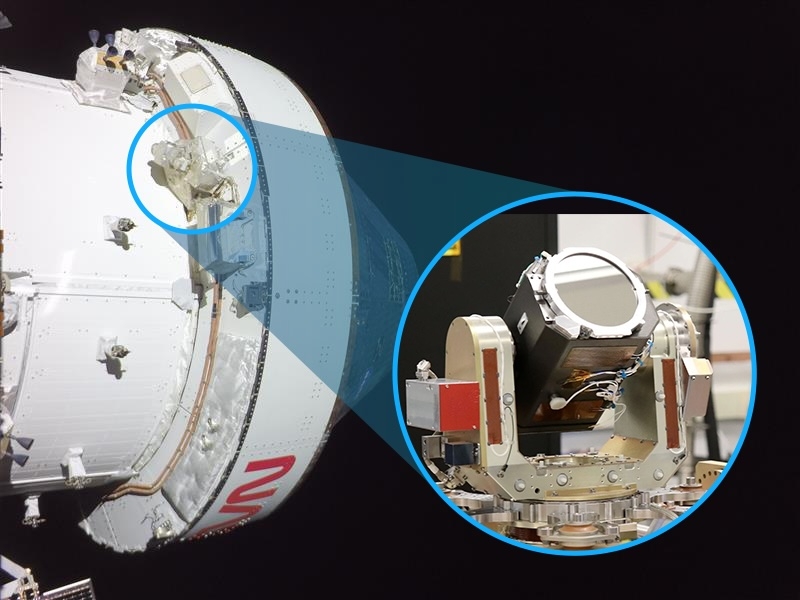
"O2O was able to downlink all the data stored on multiple onboard cameras, allowing mission control to erase the memory cards and refill them with new photos and videos," explains Khatri. "For any space mission, scientists and spacecraft engineers are concerned that data not sent down during the mission can become corrupted or get destroyed. And, when the spacecraft capsule returns, downloading the data can sometimes take months. The lasercom capability provided by O2O ensured the data were preserved and immediately available for analysis."
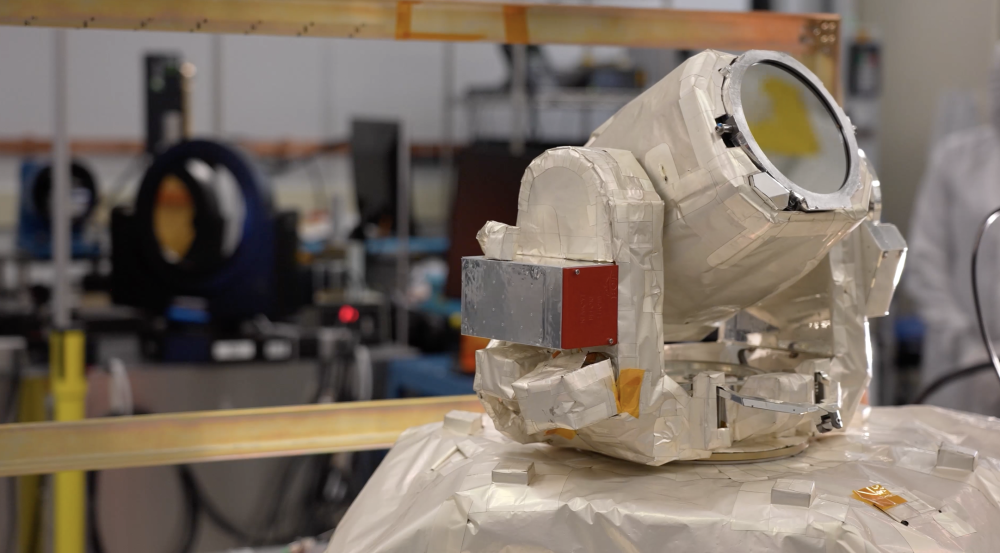
O2O is based on the Laboratory's R&D 100 Award–winning Modular, Agile, and Scalable Optical Terminal (MAScOT), which contains subassembly modules for pointing the laser beams, establishing a communications link with ground stations, and maintaining this link despite atmospheric conditions. MAScOT made its debut in space on the International Space Station in 2023, demonstrating NASA's first LEO user for their lasercom relay system.
Over the Moon for O2O
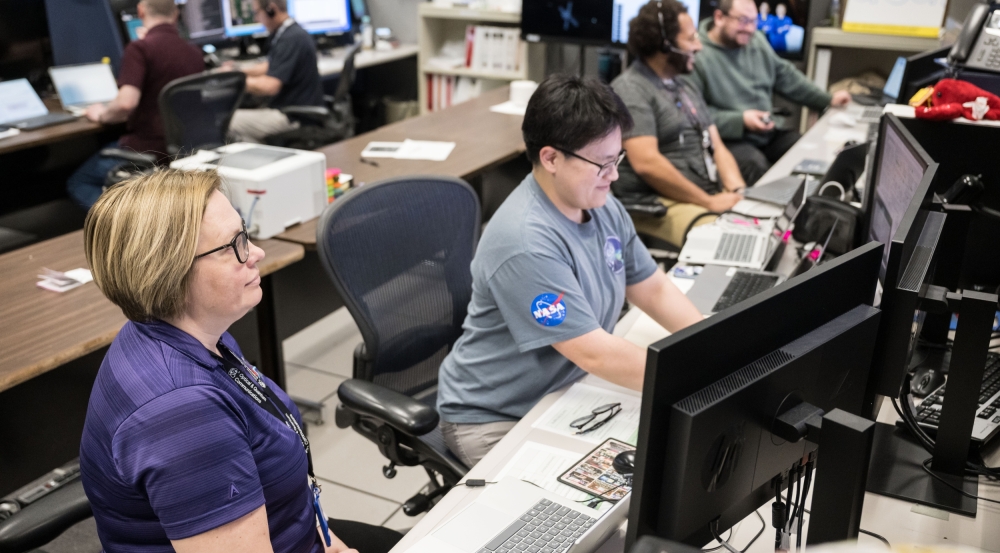
Leading up to the launch of Artemis II, operations teams from the Laboratory traveled to NASA's White Sands Test Facility and Mission Control Center to conduct monthly maintenance on ground hardware and simulate different mission stages. During the 10-day mission, Laboratory teams provided 24/7 coverage. At mission control, one Laboratory team, along with NASA Goddard colleagues, interfaced with a mission flight controller to command the O2O payload, coordinated with U.S. and Australian ground terminals to bring up the O2O physical link, assessed whether overall O2O mission requirements were being met, and analyzed data to ensure payload health and optimize performance. Another Laboratory team oversaw subsystems of the optical ground terminal at White Sands, while staff at the Laboratory's main campus in Massachusetts offered subject-matter expertise.
Initially, O2O had a scheduled operational window of one hour per day, with the onboard radio system set to downlink most data. However, mission operators found O2O so useful that they maximized its operational time as the mission progressed. On the fly, mission operators adjusted Orion's attitude — how the spacecraft is oriented in space — so that O2O could have line-of-sight access with the ground.
"One special aspect of this mission that enabled our technology to be so impactful was the flexibility built into the planning process to account for the fact that humans hadn't been to the Moon in more than 50 years and it would be the first time sending astronauts on Orion," says Bryan Robinson, leader of the Optical and Quantum Communications Group. "An established process for making real-time changes to the plan and the willingness of operators to try out this new technology had a huge impact, even for this short mission. This impact was tangible by everyone in mission operations and by the public watching from home."
With Artemis II completed, engineers, scientists, and mission specialists are analyzing mission data. Their analyses will provide insights into spacecraft and subsystem performance and Moon geology, which will inform lunar landings and deep-space exploration. While the Laboratory team is still processing O2O performance data, they believe the system could downlink at least 10 times more data by improving the efficiency of the downlink process and by addressing data-flow bottlenecks in space and ground networks.
The Laboratory team is now evaluating how lasercom could support future Moon plans for Artemis and Ignition. Aligning with the National Space Policy to secure U.S. leadership in space, Ignition is a recently announced initiative to establish a permanent lunar base with a sustainable human presence.
"Participating in this historic mission from the MCC and having O2O be useful, I couldn't have asked for anything more amazing in my career," Khatri says.
"When I came home, I was floored by the response of people who engaged with the mission while it was happening. Much of that engagement was enabled by the technology we developed. That's a rare moment in a career doing what we do," Robinson adds.
Inquiries: contact Ariana Gaines.
Related Links
- NASA laser terminal enhances views during Artemis II mission
- NASA's Artemis II crew beams official Moon flyby photos to Earth
- Lincoln Laboratory laser communications terminal launches on historic Artemis II Moon mission
- First communications user terminal demonstrated in two-way laser relay prepares for Moon flyby
- Lincoln Laboratory technologies win seven R&D 100 Awards for 2025