


Summer research interns take on national security challenges
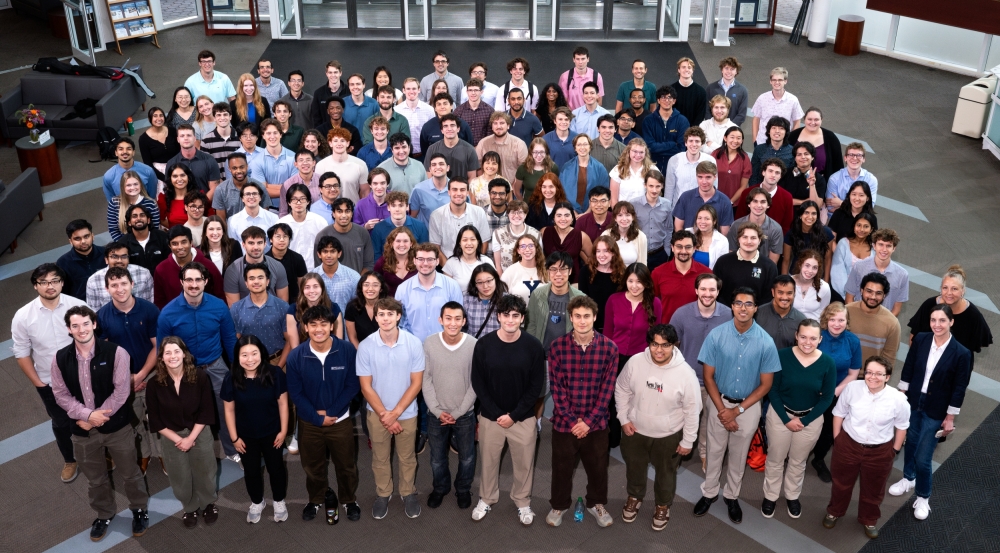
As summer winds down, nearly 170 interns are dispersing from Lincoln Laboratory to return to their undergraduate or advanced degree programs. For Anna Raymaker and Vivek Jagadeesh, however, the work is just getting started. They are among more than two dozen interns staying on as student technical assistants, continuing to support the Laboratory's national security research during the academic year.
"Our summer research program is a key pathway for developing talent to support defense-critical programs," says Robert Loynd, executive officer in the Director's Office. "Interns are embedded in R&D teams across nearly all mission areas, from missile defense and cyber operations to advanced communications and quantum technologies."
In 2026, the Laboratory's intern program was named to Yello and WayUp's Top 100 Internship Program list and received the organizations' Public Service Award. This award recognizes programs that demonstrate exceptional commitment to meaningful intern engagement that benefits the public good.
Anna Raymaker: securing maritime infrastructure

Anna Raymaker found her bearings when she began researching maritime security. Four years ago, the PhD student at Georgia Institute of Technology had just started her cybersecurity studies but hadn't yet settled on a focus area. When her advisor offered a project building a boat testbed, the Florida native was hooked.
As she began presenting her testbed research at academic cybersecurity conferences, she noticed a gap: "No one was really looking at shipping security," she says. That realization led her to speak directly with mariners to learn about the cybersecurity issues they faced.
One issue mariners repeatedly raised was the security of the Automatic Identification System (AIS), a device that helps ships avoid collisions by broadcasting their location, speed, and course. International regulations require all ships over 300 gross tons — such as cargo, tanker, and cruise ships — to transmit their identity via AIS at all times.
"Mariners told me that AIS is their source of truth, so it was very scary when they experienced it being manipulated in the wild," Raymaker says. For example, so-called "ghost fleets" could use AIS to disguise themselves as other vessel types to evade sanctions. Such deception is possible because AIS does not require identity verification.
This summer, Raymaker examined AIS security firsthand at Lincoln Laboratory. Her goal was to analyze the trust assumptions built into the system and identify where those assumptions could be exploited. Her research revealed several methods of interfering with AIS, including radio-based "spoofing," in which false messages can appear to come from a legitimate device. Spoofed messages could, for instance, instruct ships to switch transmission channels or report a fake vessel position, potentially causing ships to change course. Working with her Laboratory advisor, Hamed Okhravi, she then explored defenses against these false signals.
"Recent events have demonstrated that AIS security is not merely a theoretical concern, as manipulation or spoofing of maritime positioning data can directly affect navigation, safety, and global shipping. Anna's work directly contributes to understanding and mitigating these emerging risks," Okhravi says. "She built a new experimental testbed from scratch, conducted detailed experiments, analyzed the results, and helped turn the work into a publication, demonstrating excellent hands-on technical and research skills."
Raymaker says she has been both surprised and encouraged by the Laboratory's collaborative culture. Mentioning her AIS project in a hallway conversation would prompt staff to offer help or connect her with relevant experts. "The opportunity to network with all these experts and see what other groups do is extremely unique. Any student would benefit from that kind of exposure," she says.
As a student technical assistant, Raymaker will research other dimensions of maritime security. She's particularly interested in preventing the malicious cutting of undersea cables, which has become a major geopolitical security concern. "Ships are big and slow. If we have data on where they're moving, maybe we could use it to predict when a ship is going to do something bad," she says.
After graduation in spring, she hopes to keep working through the problems she heard from mariners: "I want to go one by one down that list to create solutions that might help. Their job at sea is hard, and they deserve to be protected."
Vivek Jagadeesh: readying cyber technology for industry adoption
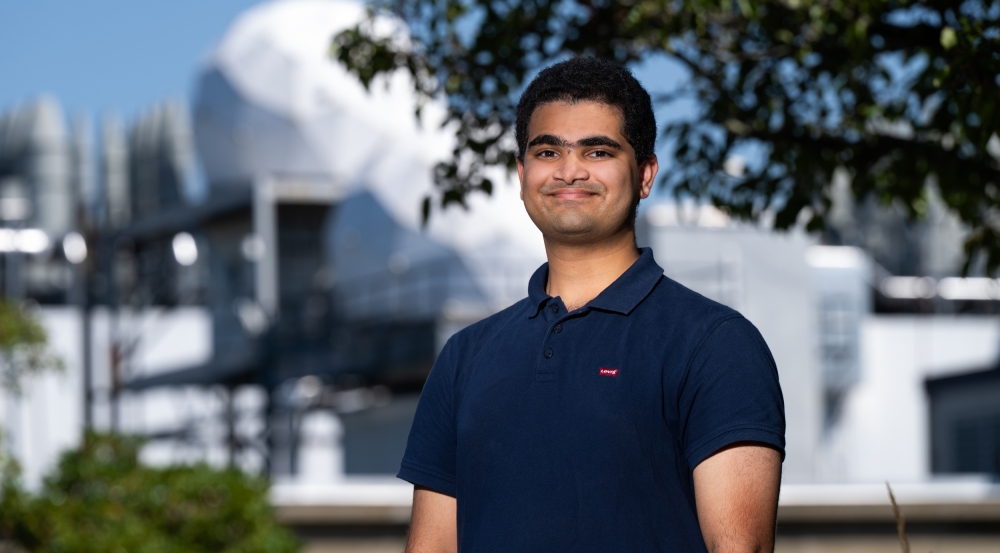
Vivek Jagadeesh is a master's student at Worcester Polytechnic Institute. His path to Lincoln Laboratory came together naturally. After interviewing for a summer position, he learned that his advisor had a connection with staff in the Secure Resilient Systems and Technology Group. That connection gave him the confidence that the Laboratory was the right fit for his interests. As it turned out, the group's work aligned closely with the problems Jagadeesh was tackling in his research: securing operating systems.
Specifically, Laboratory researchers have been developing Hardware-Assisted Kernel Compartmentalization (HAKC). The core software of an operating system, a kernel typically has the highest level of access to a computer's hardware. Because of that access, a single bug in kernel code can lead to catastrophic security failures. HAKC mitigates this risk by dividing kernel code into smaller components, each separated by access-control checks. The team anticipates that the technology can resolve vulnerabilities in Linux kernels, which power most of the world's devices.
Jagadeesh's focus has been on supporting HAKC's transition to industry. "The idea is to make the technology less proprietary, so that any of the big distributors of Linux, like Red Hat or Canonical, can use it," he says. Those distributors, however, need clear insight into how HAKC modifies the kernel code. To enable this insight, Jagadeesh developed a tool called a source-to-source compiler, or transpiler.
A compiler converts C source code into binary for machines to execute. Different compilers process code differently, and the compiler HAKC uses differs from the compiler used frequently by the greater Linux community. Modifications to code are usually done at an intermediate stage — a translated version of the code that compilers use before generating binary — but interfacing with the code at this stage varies by compiler, making modifications hard to transfer between systems. To avoid this problem, Jagadeesh's transpiler inserts HAKC code directly into the original C source file, while preserving the source file's original information and making additions easily identifiable. As a result, any developer can audit the changes HAKC implements, and HAKC can cleanly integrate into the complicated build systems used by kernel developers and distributors.
"Creating a transpiler is a non-trivial task, but that is nevertheless what Vivek achieved. His transpiler is capable of transforming the entire Linux kernel, a key milestone we need to bring HAKC to industry," says his Laboratory advisor, Derrick McKee, who began developing HAKC as a student researcher himself five years ago.
According to McKee, the transpiler will serve as the foundation for the next iteration of HAKC. That new version is planned for release under the Open Resilient Compartmentalization Alliance, a Linux Foundation initiative dedicated to bringing compartmentalization technology to Linux systems.
Jagadeesh says he felt strongly supported throughout the internship, meeting with the project's two principal investigators at least twice a week. "It felt like we were working on this together in a big way — and I got a lot of support from everyone responsible for it," he says. He looks forward to working on other aspects of system security in the group this fall.
For students considering a Laboratory internship, Jagadeesh offers this perspective: "You get to work on real things that have an actual impact. It's work that, after you go back to school, you'll apply to more research going forward."
More information on Lincoln Laboratory's summer research program and other student opportunities can be found here. Media inquiries: contact Kylie Foy.