


Novel Design for Small, Low-Cost Hydrophone
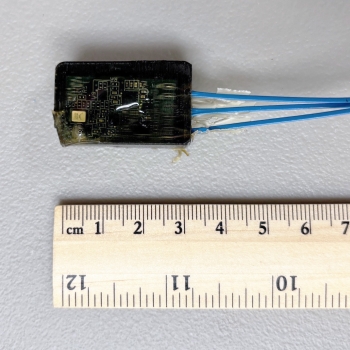
A first-of-its-kind hydrophone offers significant reductions in size and cost compared to commercially available hydrophones while achieving state-of-the-art performance. The key to the design is a microfabricated microphone whose millimeter-scale components free up space within the device for electronics that can process and digitize signals on chip rather than transmitting analog signals over cables to a remote processing center. This “onboard” signal handling eliminates the number of cables needed to manage an array of hydrophones, enabling deployment of more units for wider-ranging undersea sound monitoring.
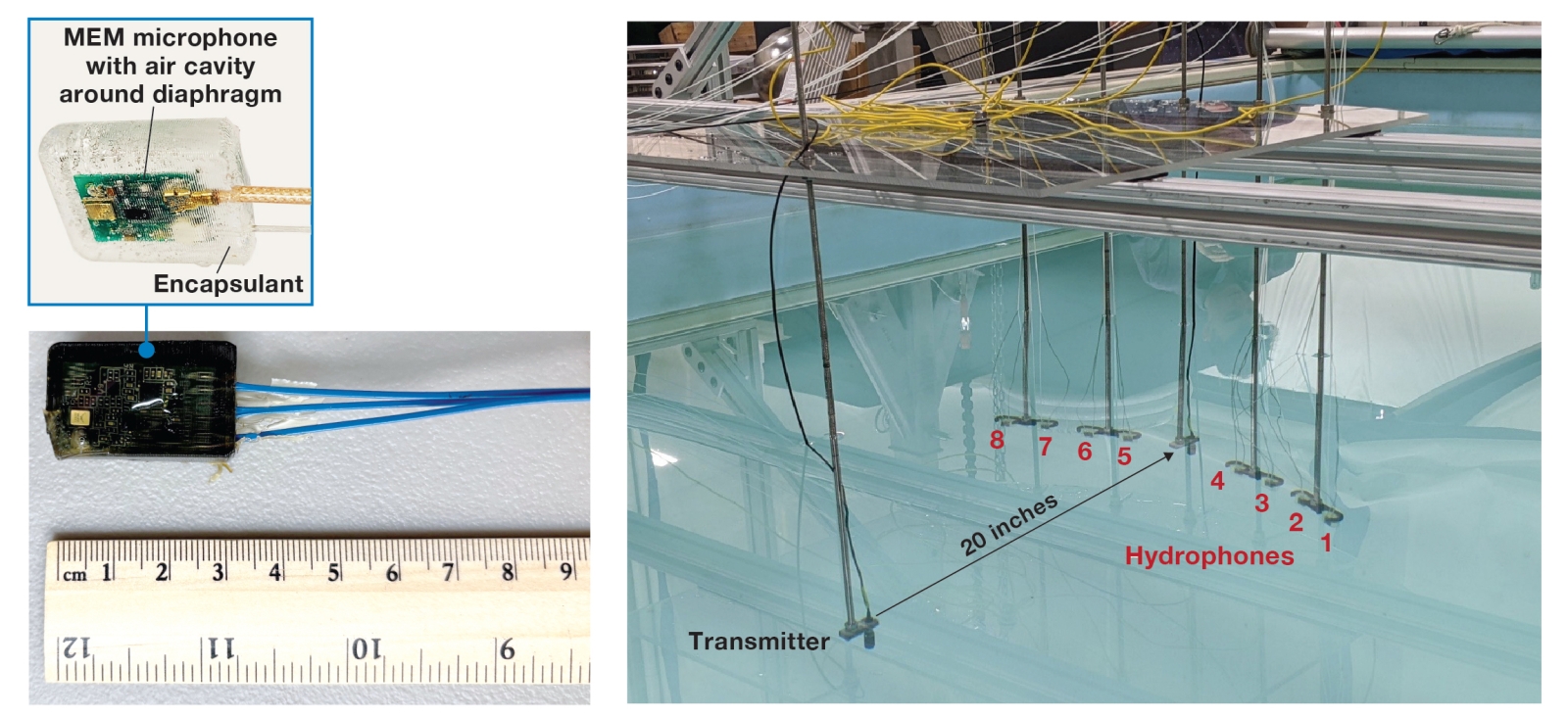
The miniature hydrophone (left) consists of a printed circuit board housing a microelectromechanical (MEM) microphone and a preamplifier. The entire device
is encapsulated in polymer. At right, prototypes of the hydrophone were tested in the pool at Hanscom Air Force Base prior to field testing in a deep-water lake.
Motivation
Hydrophones are essential instruments in monitoring the undersea environment and activities. From tracking marine wildlife movement, to analyzing effects of undersea pipelines, to monitoring underwater vehicles, hydrophones let people hear what is going on deep beneath the surface of the water. Yet sensitive, commercially available hydrophones are expensive, and deploying large arrays of hydrophones to cover broad expanses of ocean has meant using an extensive network of cables to relay acoustic signals to ships or onshore facilities for processing.
Innovative Solution
In collaboration with colleagues at Tufts University and industry partners at SeaLandAire Technologies and Navmar Applied Sciences Corporation, Lincoln Laboratory researchers investigated the feasibility of designing a hydrophone that could be cost-effective, high-performing in deep water and cold temperatures, and deployable over a large area. Developing a custom-built hydrophone would be an expensive solution, so the team looked at modifying a commercially available microphone.
The resulting hydrophone is built around a conventional circuit board made from an industry-standard composite and utilizes a MEMS microphone, identical to those used in smartphones; integrated circuits for amplifying and digitizing the acoustic signal from the microphone; and a protective low-permeability polymer encapsulant for allowing underwater acoustic-signal transmittal. A key design feature is the air cavity surrounding the input port of the microphone. This cavity’s size and shape can be customized.
Testing verified that the excellent sensitivity of the MEMS microphone offsets any signal loss produced by the incorporation of air into the device. In demonstrations at Seneca Lake in New York, hydrophones were lowered to increasing depths in the water—100 feet at first, then incrementally lower down to 400 feet. At each depth, acoustic signals transmitted at various frequencies were amplified, digitized, and recorded for analysis of the hydrophones’ sensitivity. Results showed that the sensitivity and the signal-to-noise ratio was within a few decibels of the quietest ocean state, known as sea state zero. Moreover, this performance was achieved at a depth of 400 feet and a temperature of around 40 degrees Fahrenheit.
Benefits
- Built around an inexpensive commercial MEMS (microelectromechanical system) that uses a tiny, high-precision electroacoustic transducer on a silicon chip
- Operates underwater through its encapsulation in polymer and use of an air cavity around the diaphragm (the component of the microphone that vibrates in response to sound waves)
- Functions successfully at depths up to 400 feet, sufficient for most applications of interest
Additional Resources
"Small, inexpensive hydrophone boosts undersea signals," October 6, 2025