


Advanced Technology
In the quest to develop a quantum computer, the ability to fabricate high-quality superconducting circuits provides a major advantage. These circuits, when operated at extremely low temperatures, function as quantum bits (qubits), the basic units of data in a quantum computer. However, superconducting qubits are very difficult to fabricate, and a major barrier to groups pursuing this research is the expensive tooling and specialized processes required to make these circuits.
Through the SQUILL Foundry, we can make complex, coherent devices that enable us to do experiments far beyond what we can achieve with internal fabrication.
Prof. Eli Levenson-Falk
University of Southern California, SQUILL Foundry User
The Superconducting Qubits at Lincoln Laboratory (SQUILL) Foundry is removing this barrier. Sponsored by the Laboratory for Physical Sciences, the program makes our cutting-edge fabrication capabilities available to institutions conducting U.S. government–funded research. Researchers submit quantum circuit designs for fabrication, and the completed circuits are returned to advance scientific inquiry at their home facilities. To date, the SQUILL Foundry has delivered more than 400 fabricated devices to over 30 research groups investigating a range of topics — from probing fundamental questions about quantum information to developing the building blocks of quantum memory.
Lincoln Laboratory has more than 20 years of experience fabricating superconducting qubits with world-class performance. We make the qubits on site at our Microelectronics Laboratory, considered to be one of the U.S. government's most advanced foundries. SQUILL leverages these tools in a high-mix, low-volume approach that enables the flexibility to produce small quantities of many different devices while maintaining high quality, which is crucial for supporting a large and diverse range of research programs.
30
research groups supported across the nation
400
devices delivered to users
120
publications and academic presentations featuring device results
Biotechnology & Human Systems
Biomanufacturing secures supply chain for critical defense materials
Access to many critical defense materials, such as rocket propellants and autonomous vehicle protective shielding, is vulnerable to geopolitical conflict. In 2023, the U.S. Government Accountability Office found that more than 90% of defense-critical materials in short supply had only one or no domestic supplier. This lack of supply chain resiliency leaves the nation vulnerable to supply disruptions if mass-producing foreign countries like China cut off access to gain military or commercial advantage.
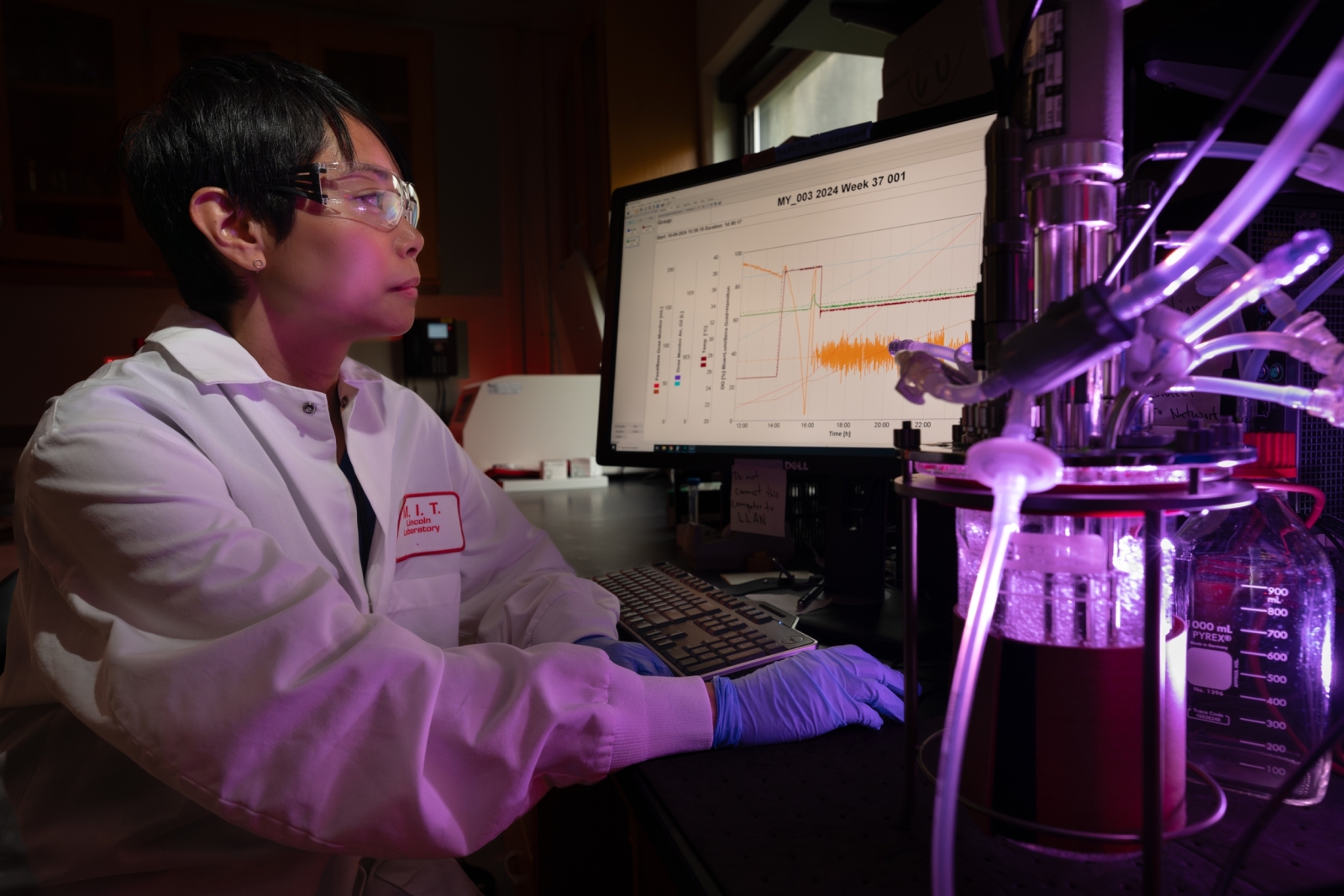
Judilee Osborn uses software to control and monitor critical parameters of a fermentation run, a bioprocess in which organisms such as bacteria and yeast are grown to high cell densities to either generate enzymes or convert one chemical into another.
Lincoln Laboratory has developed new biomanufacturing methods that promise to drive U.S. production of defense-critical materials. These methods use living cells and enzymes as their engines, and abundant, cheap, and domestically available raw materials as their fuel. They break away from traditional chemical synthesis, which relies on expensive materials subject to unstable foreign import conditions and consumes significant energy, leading to high production costs.
In 2025, the Laboratory became the first to synthesize, through biomanufacturing, a key defense material and critical nitrated products used in propellants. When scaled, these synthesis techniques could improve U.S. manufacturing self-sufficiency, safety, and hazardous waste management. Next in the pipeline are stronger, cheaper, and on-demand materials for bulletproof applications.
Advanced Technology
Integrated photonics revolutionize microwave systems
Microwave systems are critical to radar and communications, using high frequencies and large bandwidths to enhance target identification, secure data transfer, and counter signal interference. Now, Lincoln Laboratory is delivering photonic integrated circuits (PICs) to advance the next generation of microwave systems.
All within a microchip, our PIC platform converts microwave signals into optical signals, processes these signals using photonic components (those that manipulate photons, or light), and then converts them back. Leveraging optical signals offers 180 times larger bandwidth and 1,000 times lower loss compared to conventional electronics. While widely used in telecommunications and data centers, PICs adapted for microwave systems have historically faced performance challenges. After decades of research, our team has now optimized photonic components and materials for microwave applications — developing best-in-class lasers, photodetectors, and modulators, integrating them onto a silicon substrate, and connecting them via waveguides to route light through the chip. The ability to conduct all fabrication steps under one roof is unique to Lincoln Laboratory.

This photonic integrated circuit (measuring 3 x 0.5 cm) contains all the photonic components required for filtering and frequency down-converting millimeter-wave signals.


