


The Technology Office oversees Lincoln Laboratory's strategic technology investments and cultivates technical partnerships beyond the Laboratory. By regularly engaging with the Office of the Under Secretary of War for Research and Engineering (OUSW [R&E]) and other government entities, we identify both long-term and emerging national security priorities. We then administer funding provided by OUSW (R&E) to drive the development of new capabilities to address those needs.
This R&D funding, which is independent of our government-sponsored research program funding, fosters an innovation pipeline. Technologies initiated through this investment portfolio often progress into sponsored research programs within a core mission area; are acquired at a classified level by the DoW; or are licensed and commercialized for the benefit of the U.S. economy, security, and society.
To support these objectives, the Technology Office also fosters collaborations with MIT and other universities, and spearheads initiatives to encourage an innovative culture at the Laboratory.
Technology investment outcomes
Our internal portfolio advances capabilities across the defense and innovation ecosystem. From 2021 to 2025, Technology Office investments resulted in 123 technology transfers to recipients in the following categories.
Advanced Devices
Can superconducting computing power the next generation of AI?
Modern data centers consume enormous amounts of power. As AI applications expand, more powerful and efficient computing infrastructure is needed to meet growing demands. Superconducting electronics, using quantum effects of Josephson junctions rather than transistors, use 100,000 times less power than conventional transistors per basic switching operation. Once cooled to cryogenic temperatures, superconducting computing chips could in principle reduce power consumption by up to 100 times compared to traditional semiconductors. This efficiency could also enable powerful AI capabilities at the tactical edge where power is limited.
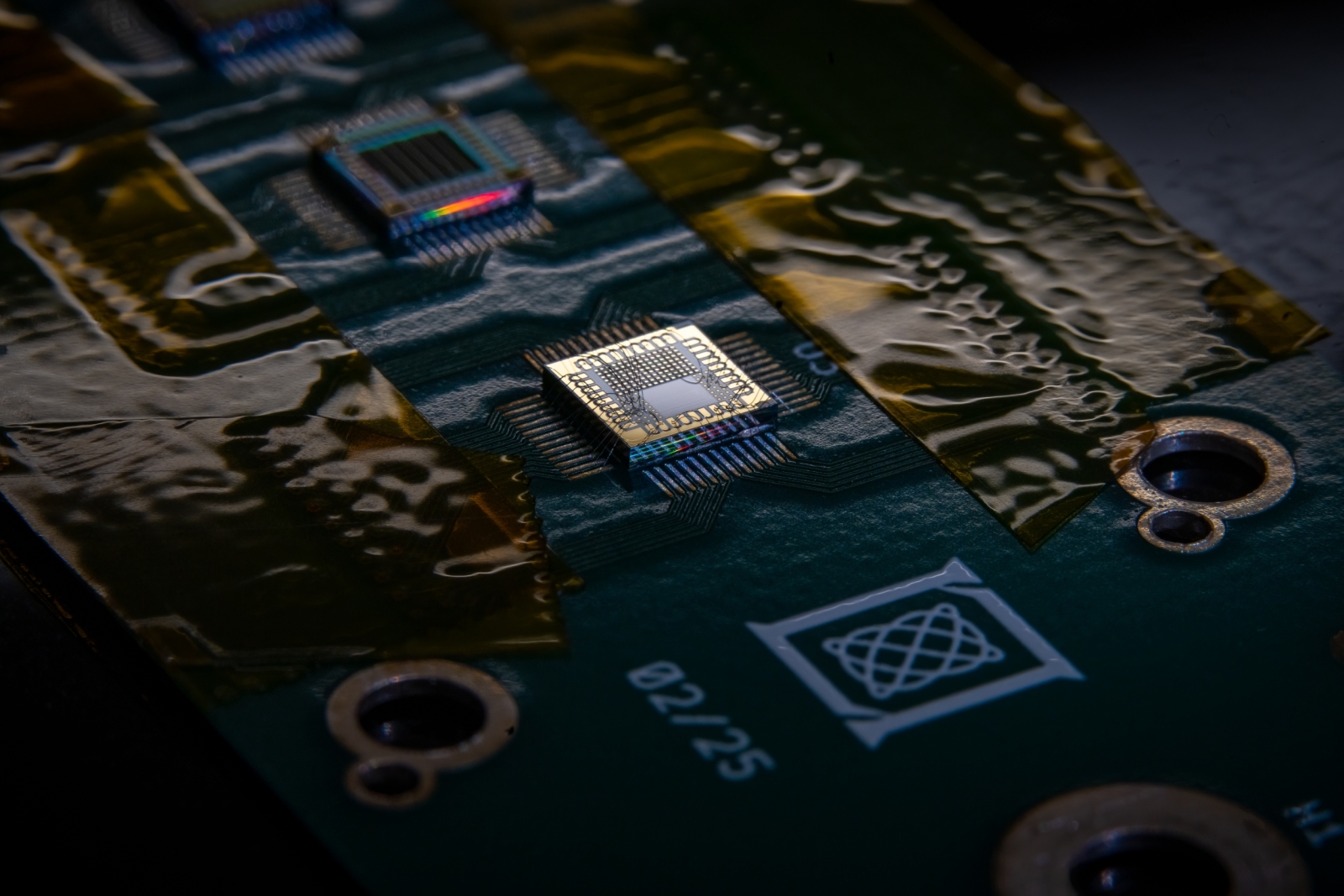
This wire-bonded chip contains superconducting circuits designed to drive radical advancement in computer power efficiency.
We are tackling the technological challenges of scaling superconducting electronics to deployable and data-center-sized systems. In 2025, we achieved a significant milestone: fabrication of our first-generation superconducting computing core chip. Comprising 15,000 Josephson junctions and 50,000 inductors, the chip is now undergoing evaluation at the Laboratory to test key capabilities, such as memory storage and floating-point instructions. Building on this work, we will continue to improve superconducting chip architectures, memory systems, and multicore interconnects — scaling to compete with cutting-edge silicon graphics processing units and tensor processing units. In collaboration with the MIT Center for Bits and Atoms, researchers are spinning out a startup company, Adiabatic Machines, to accelerate the transition of this technology to the commercial sector.
Critical Infrastructure Technologies
Can growing vine robots reach where humans can't?
When buildings collapse, victims can become trapped within unstable, inaccessible piles of rubble. To assist responders in navigating these hazardous environments, we are developing soft, growing "vine" robots capable of extending into tight, confined spaces while carrying sensors along their length. Unlike rigid tools such as telescoping cameras, these flexible robots can safely maneuver through complex environments — pipelines, engines, and collapsed structures — without endangering human lives.

The prototype vine robot penetrates void spaces in an engineered collapsed building at the Massachusetts Task Force 1 training facility in Beverly, Massachusetts.
Capable of extending dozens of meters, our vine robots represent a significant advancement in continuum-robot design, control, and embedded sensing. Integrated fibers equipped with acoustic and inertial sensors collect environmental data at multiple points along the robot's body, enabling precise navigation and real-time information sharing with operators. Advanced algorithms fuse auditory and positional data, allowing the robots to locate sound sources in confined spaces. This technology has broad applications in national security, including battle damage assessment, infrastructure inspection, and urban search and rescue. In collaboration with researchers at Notre Dame University, we have prototyped a vine robot system that is now undergoing field testing.
Autonomous Systems
Can game theory outmaneuver adversaries in real time?

Above Edwards Air Force Base, the X-62A VISTA test aircraft (red) demonstrated the first AI-piloted dogfight in 2024. EDGES builds on this work, using game theory to compute optimal actions in real time. Photo: Richard Gonzales, U.S. Air Force
Military combat operations such as aerial dogfighting require split-second decisions and high-skill maneuvers against intelligent adversaries. Such demands have long kept these operations under human control. More recently, efforts in autonomous decision-making for adversarial scenarios have relied on machine learning techniques that require massive amounts of training data and can behave unexplainably. Our Edge-Compute Differential Game Solver (EDGES) offers a fundamentally different solution. Using differential game theory, EDGES mathematically models competing agents' dynamics and then leverages optimal control principles to solve for the best action against multiple adversaries at any moment in time. By repeatedly solving this problem with real-time feedback, EDGES keeps a combat agent's tactics current with opponents' latest maneuvers.
EDGES algorithms can produce decisions in fractions of a second on board an aircraft. In 2025, EDGES solved simulated fighter maneuvers between two F-16 aircraft, one of the most complex problems ever tackled with game theory. Looking ahead, we will also apply EDGES to improve counter-drone swarm planning and support autonomous satellite maneuvering.
Cybersecurity
Can cloud and virtual machines be mission secure?
Hypervisors are a type of software foundational to cloud computing, enabling data centers to manage thousands of virtual machines. Both the DoW and the intelligence community rely on cloud infrastructure and virtualized environments for mission-critical operations. However, our study on zero-trust security identified that hypervisors require fundamental redesigns to achieve true resilience against cyberattacks. Current hypervisor security relies on eliminating vulnerabilities through bug-finding techniques and specialized hardware. In contrast, our resilient hypervisor, Hy-Rez, acknowledges that vulnerabilities are inevitable and neutralizes them to prevent exploitation. Hy-Rez achieves resilience through compartmentalization, dividing the hypervisor into smaller, isolated components with limited privileges. This design ensures that a vulnerability in one component cannot compromise an entire system.
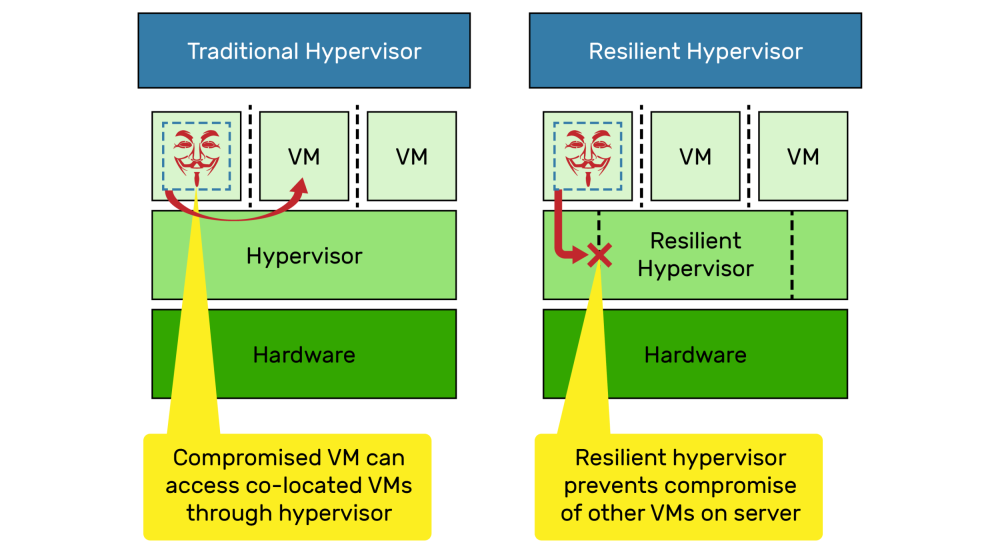
The Hy-Rez technology uses compartmentalization techniques to isolate compromised virtual machines.
Today, modernization efforts across the DoW are shifting to cloud and virtualized setups, making a resilient hypervisor increasingly critical. Hypervisors will underly swaths of capabilities, from submarines to satellite ground systems, and form the backbone of Joint Cyber Warfighting Architecture and Joint All-Domain Command and Control networks unifying warfighters and their systems. To transition Hy-Rez into operational use, we are pursuing open-source commoditization and collaborating with industry leaders such as Amazon Web Services, Google, and Red Hat to accelerate adoption.
Intelligent Systems
Can human-AI teaming dive underwater?
Advances in AI are enabling intelligent teamwork between humans and machines. But this teaming has yet to be brought underwater because of significant hurdles in real-time communication, perception, and navigation. Working with the MIT CSAIL Marine Robotics Group, we are developing navigation and AI perception algorithms and supporting hardware that integrate the complementary strengths of humans and autonomous underwater vehicles (AUVs). Humans excel at interpreting ambiguous information and classifying objects, while AUVs are adept at collecting, processing, and distilling quantitative sensor data. By bridging these strengths, we aim to optimize diver-robot teaming during critical infrastructure inspection and repair, search and rescue, harbor entry, countermine operations, and other maritime missions of the U.S. military.
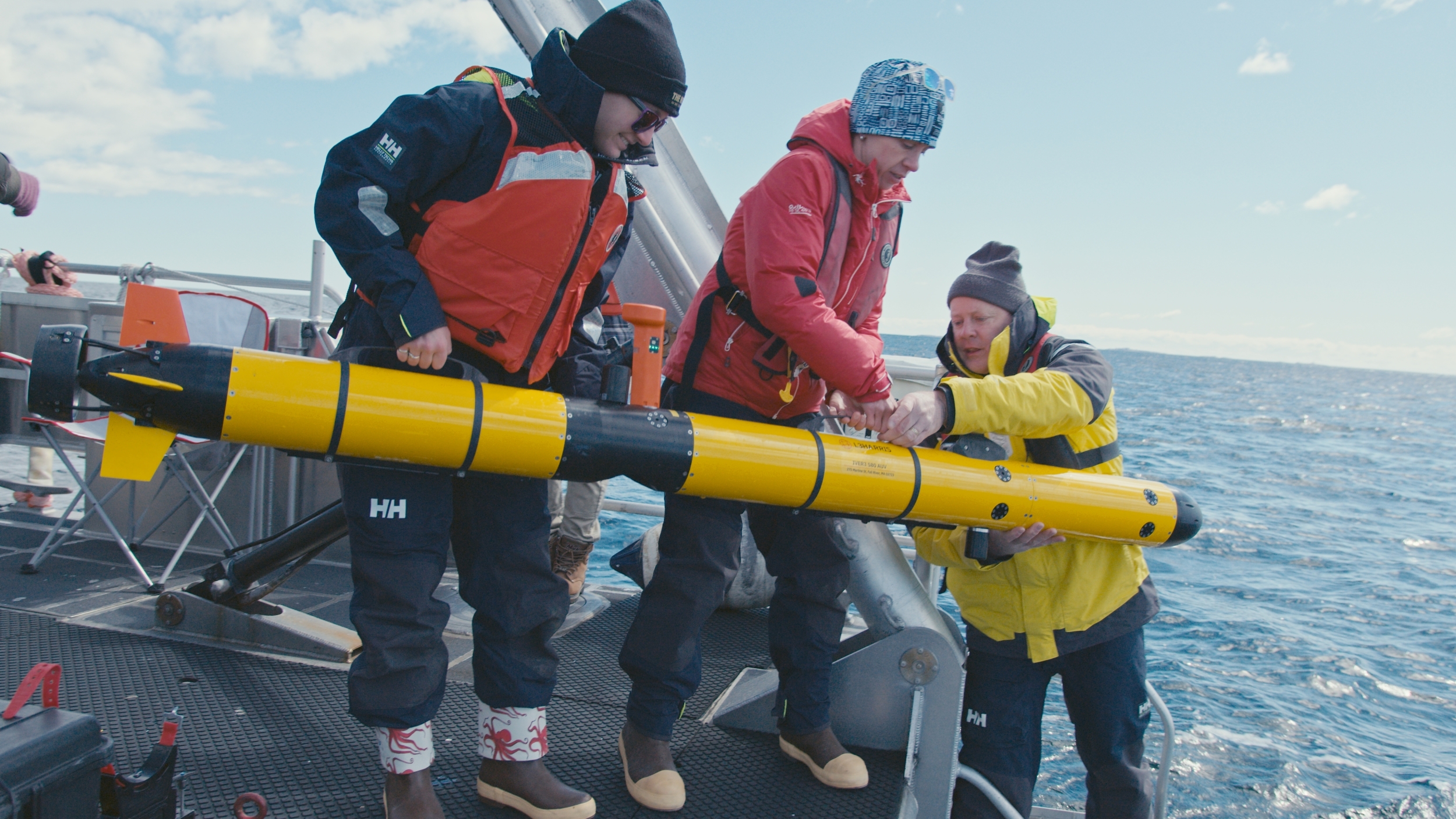
Ella Wawrzynek, Madeline Miller, and David Whelihan deploy their sensor-equipped AUV into the Atlantic Ocean.
Maintaining global economic security and U.S. strategic advantage in the undersea domain will require leveraging and combining the best of AI and human capabilities.
Madeline Miller
Principal Investigator
Biomedical Sciences and Technologies
Can all blood types be universal?
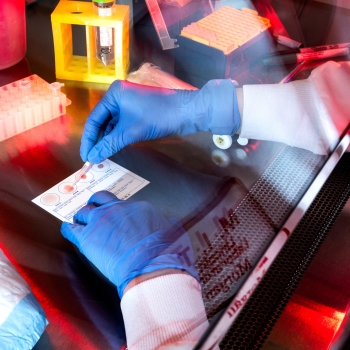
Blood is applied to an EldonCard to verify successful B‑to‑O conversion.
Imagine a future where medics, whether on the battlefield or in remote disaster zones, can make any blood donation compatible with any recipient. Each year, a unique Technology Office Challenge is presented to the Laboratory community to tackle an emerging national security problem. The 5T (Triage, Transmit, Track, Transport, and Train) Casualty Care Challenge focused on enhancing the DoW's capabilities to respond to mass-casualty events. The winning concept proposed using enzymes to cleave B and A blood antigens, thereby making any blood type universally compatible.
Now funded under our investment portfolio, this concept could bolster blood supplies in combat and disaster-response scenarios, addressing needs identified by the Defense Health Agency. The research team is initially focused on converting type B whole blood into universal type O whole blood, with the long-term goal of expanding universal compatibility to 99% of blood donations. The team is also building portable blood-conversion devices that can be deployed in the field to support blood-type conversions at the point of injury. Ensuring that donor blood is available to anyone, anywhere, represents a major frontier in emergency medicine.
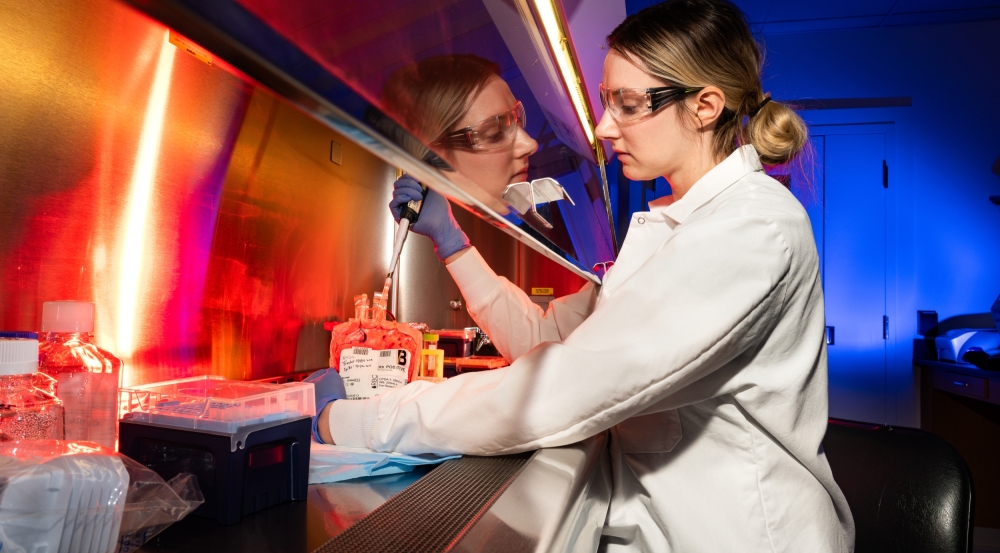
Morgan Burt extracts a sample from enzyme-converted O whole blood for downstream analysis.
Quantum System Sciences | Integrated Systems
Can optical clocks be truly portable?
Optical clocks achieve exceptional precision by using lasers to monitor narrow optical transitions of ions or atoms, making them 100 to 1,000 times more accurate than microwave clocks. However, optical clocks typically require bulky and stable setups, making them impractical to field. In collaboration with NASA's Jet Propulsion Laboratory (JPL), we are developing a compact optical clock system that fits within a cubic-liter-scale package.
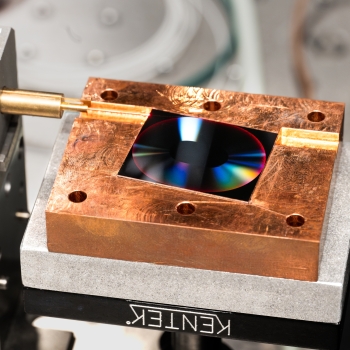
Our integrated resonator, shown on the copper mount at left, enables laser linewidths below 20 Hz, sufficient to serve as the local oscillator for an ultrastable optical atomic clock.
Our team is contributing the clock's ion trap integrated with photonics. Within a small chip, integrated waveguides deliver and focus laser light on an ion confined above the chip's surface to probe and read out its frequency. We are also developing an ultrastable integrated resonator to enable an on-chip narrow-linewidth laser that serves as the clock’s local oscillator. Concurrently, JPL is designing a miniature, all-titanium vacuum package to provide a controlled environment to house the ion trap. We aim to demonstrate clock stability with errors as small as 10-16, far exceeding the performance of previous-generation microwave clocks or masers.
Truly portable optical clocks would support key national security applications — enabling precise synchronization of distributed radar systems to detect objects at greater range or providing extended timing holdover in systems if GPS signals are disrupted, for example.
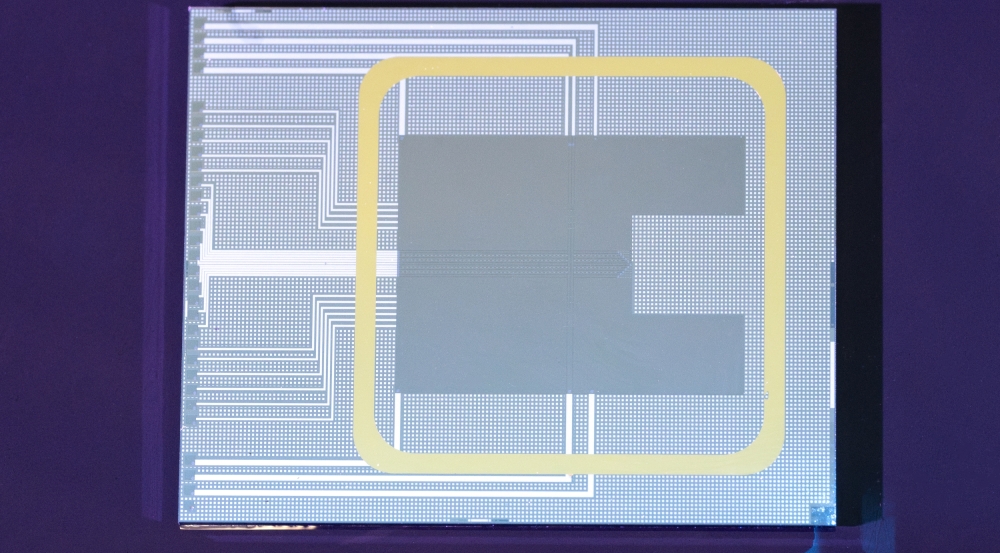
The gold sealing ring deposited on top of our ion trap enables a vacuum-tight connection to JPL's all-titanium package.


