


Communication Systems
To achieve decision-making advantage, U.S. and allied forces must be connected across air, land, sea, space, and cyber domains. Realizing Combined Joint All-Domain Command and Control (CJADC2) requires integrating each military service's communication networks into a unified common architecture for rapid data sharing at the tactical edge, where connectivity is often limited or disrupted.

Scott Arbiv and Ted Richards monitor network performance as emulated traffic (airplane symbols) generated on an Air Force node is published to JTEN, where disadvantaged users subscribe to content based on geography or entity type (hostile or friendly).
Leveraging networking architectures of the U.S. Air Force and Navy, a government team including Lincoln Laboratory and other defense contractors developed the Joint Tactical Edge Network (JTEN). By overlaying a joint network over existing networks, JTEN enables warfighters to directly communicate with cross-service mobile tactical platforms while sharing data through multiple available paths as needed. A publish-and-subscribe content-routing model ensures JTEN users obtain only relevant data — a benefit especially for disadvantaged users.
In collaboration with the Air Force, Navy, and Army, we supported JTEN testing at two large-scale military test events: a 2024 risk-reduction exercise and 2025 field training exercise. Our staff co-created joint configurations for an Internet Protocol (IP) router operating over commercial beyond line-of-sight links and DoW-owned line-of-sight links, and prototyped a content router. Utilizing airborne test beds from our Flight Test Facility, participants demonstrated machine-to-machine sensor tasking and executed a joint kill chain through JTEN nodes. Lessons learned are shaping joint interoperability requirements for CJADC2.
Cyber Security & Information Sciences
Secure architecture for uncrewed systems becomes DoW standard
Uncrewed systems are integral to modern military operations in the air, at sea, and on land. From force projection and electronic warfare to explosive ordnance disposal and intelligence, surveillance, and reconnaissance, these platforms carry out high-risk, high-impact tasks while reducing danger to warfighters. As their use expands, so does the need to protect their communications against interception or spoofing, especially in contested or disconnected environments.
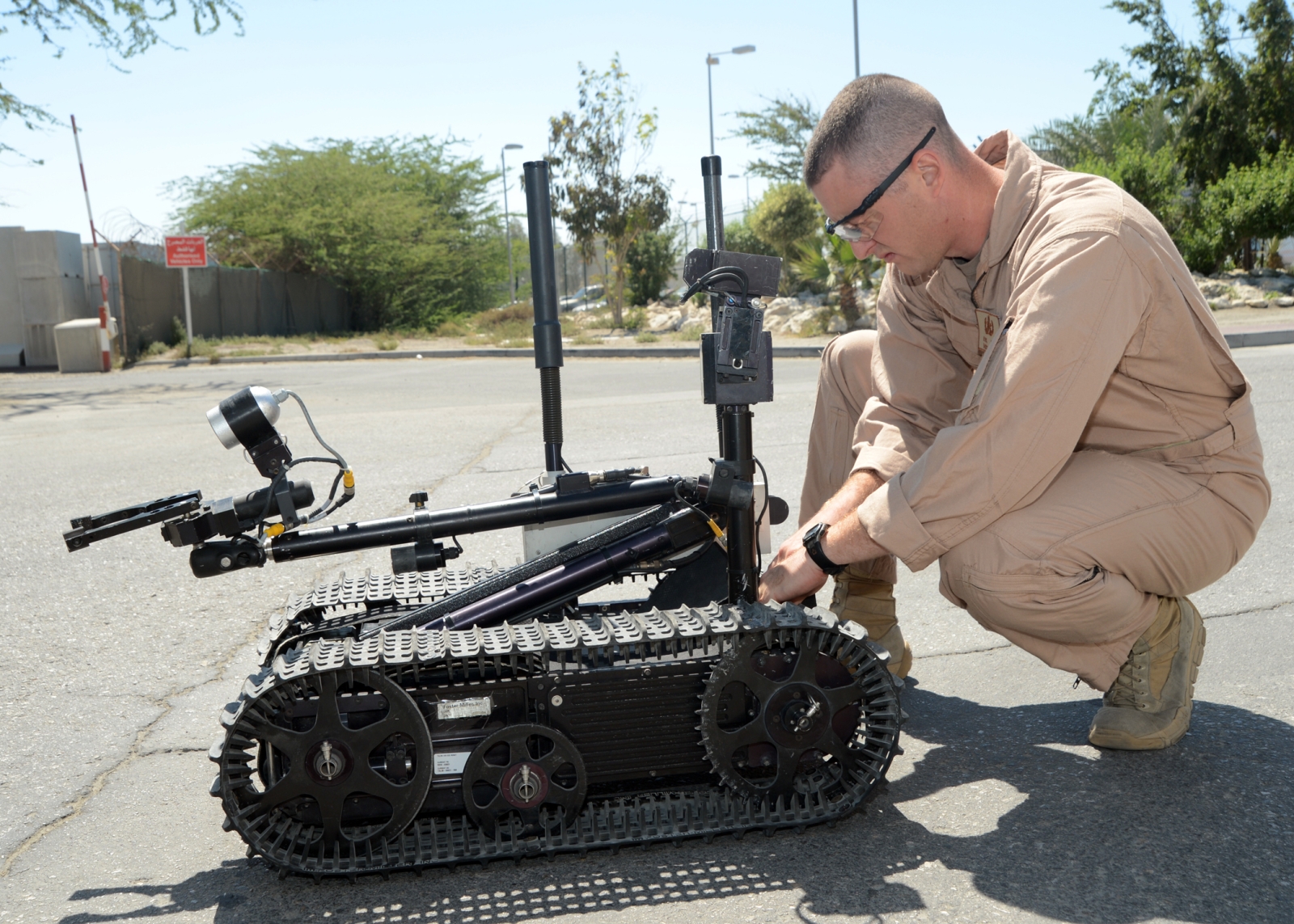
A U.S. Navy technician prepares an explosive ordnance disposal (EOD) robot. Integrated into Navy radios on EOD robots, the Laboratory-developed SCM/ECU will ensure robot actions are not communicated to unauthorized persons. Photo: Jamar Perry, U.S. Navy
Meeting this challenge demands a common architecture for secure communications — one that facilitates interoperability, reuse, and streamlined certification across various platforms. In support of this forward-looking vision, Lincoln Laboratory, in collaboration with government and industry partners, led the development of the cybersecurity architecture for the Joint Communications Architecture for Unmanned Systems (JCAUS). In 2022, JCAUS was formally adopted as a DoW standard.
Central to the first generation of JCAUS radios is the Security/Cyber Module (SCM) End Cryptographic Unit (ECU), a compact, National Security Agency–certified device that we designed and developed to enable classified communications with encryption and agile, over-the-air keying. In 2024, the SCM ECU was transitioned to industry for production and integration into the Navy's Flexible Cyber-Secure Radio for ground robots — the first of many systems across the DoW expected to be secured under this new architecture. Since then, JCAUS capabilities and technologies have continued to evolve through broader operational adoption, new secure communications implementations, and expansion into emerging mission areas for next-generation uncrewed systems.
Communication Systems
Demonstration of protected tactical waveform secures future of joint warfighter SATCOM
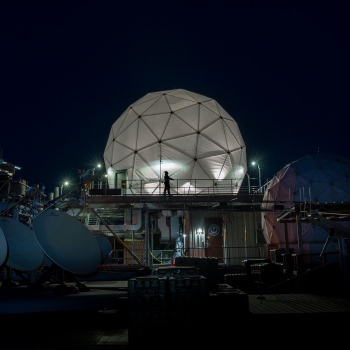
Lincoln Laboratory's Multi-Band Test Terminal, whose radome housing a SATCOM antenna is illuminated above, supports PTW development and demonstration.
The U.S. Space Force's Space Systems Command is developing the Protected Tactical Enterprise Service (PTES) to provide military personnel with the secure, high-throughput, anti-jam satellite communications (SATCOM) needed to conduct tactical missions over great distances across ground, sea, and air domains. A critical component of PTES is the Protected Tactical Waveform (PTW), which combines frequency hopping (signals rapidly "hop," or switch, between different frequencies in a sequence known to authenticated transmitters and receivers) with advanced security features and adaptability to changing satellite link conditions. Equipped with PTW, PTES ground hubs and user terminals will securely connect warfighters over military and commercial satellite constellations while protecting communications from expanding electronic warfare threats.
Lincoln Laboratory recently led a government partnership with industry to integrate a PTES ground hub's PTW capabilities and demonstrate end-to-end protected tactical SATCOM in the presence of dynamic interference. Using industry-produced PTW modems in an operationally relevant scenario, joint warfighters achieved several firsts — frequency hopping at variable interference levels, over-the-air operations via multiple PTW-enabled terminals, a secure Voice over Internet Protocol call, and ground bounce of signals via a commercial SATCOM satellite — which lay the foundation for future operations with PTES.
This demonstration culminates years of industry and government partnership to realize a modern, anti-jam, low-probability-of-intercept waveform that will underpin future tactical SATCOM operations.
Erin Carper
Former senior program director, Space Systems Command


