


Communication Systems | Engineering
Developed at Lincoln Laboratory through its advanced engineering capabilities, the Modular, Agile, Scalable Optical Terminal (MAScOT) was installed on NASA's Artemis II Orion spacecraft at Kennedy Space Center in 2025. The terminal was designed to demonstrate laser communication (lasercom) technologies, which are poised to revolutionize how spacecraft communicate.
About the size of a house cat, MAScOT integrates a four-inch telescope mounted on a two-axis gimbal for precise pointing and tracking of laser beams. Its backend optics assembly includes light-focusing lenses, tracking sensors, fast-steering mirrors, and other components that enable fine control of the laser beam for high-speed data transmission.
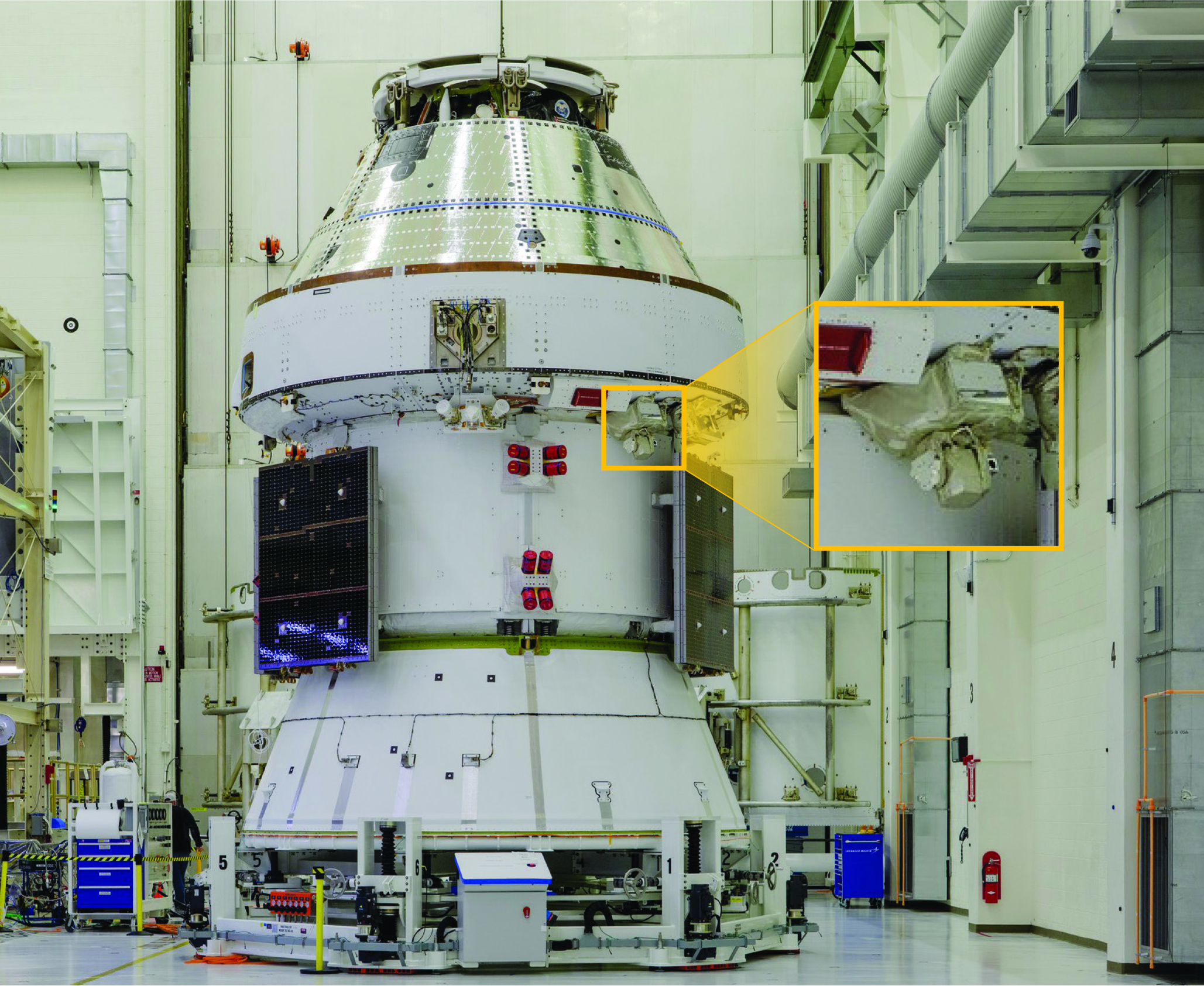
MAScOT is shown installed on the exterior of the Artemis II Orion spacecraft. Photo: Rad Sinyak, NASA
MAScOT first demonstrated its capabilities as part of the Integrated Laser Communications Relay Demonstration (LCRD) Low Earth Orbit (LEO) User Modem and Amplifier Terminal (ILLUMA-T), which launched to the International Space Station in November 2023. ILLUMA-T transmitted data to NASA's LCRD satellite 22,000 miles above Earth's surface, and LCRD subsequently relayed the communications to ground stations, successfully demonstrating the first two-way, end-to-end lasercom relay system.
Our engineers seamlessly integrated design, fabrication, analysis, controls, rapid prototyping, and optical and digital engineering to realize a single terminal that could be deployed in LEO for ILLUMA-T and cislunar orbit for Artemis II. This multidisciplinary approach has ensured MAScOT's reliability and performance for these vital missions and is poised to enable industry to replicate the terminal for future space communications.
Space Systems & Technology | Engineering
High-performance weather instruments transition to industry
In 2023, Lincoln Laboratory commissioned a five-satellite constellation for NASA's TROPICS (Time-Resolved Observations of Precipitation structure and storm Intensity with a Constellation of SmallSats) mission. The satellites hosted a unique, miniaturized version of an instrument called a microwave sounder, which typically makes measurements of atmospheric humidity, temperature, and precipitation from very large, multibillion-dollar satellites.
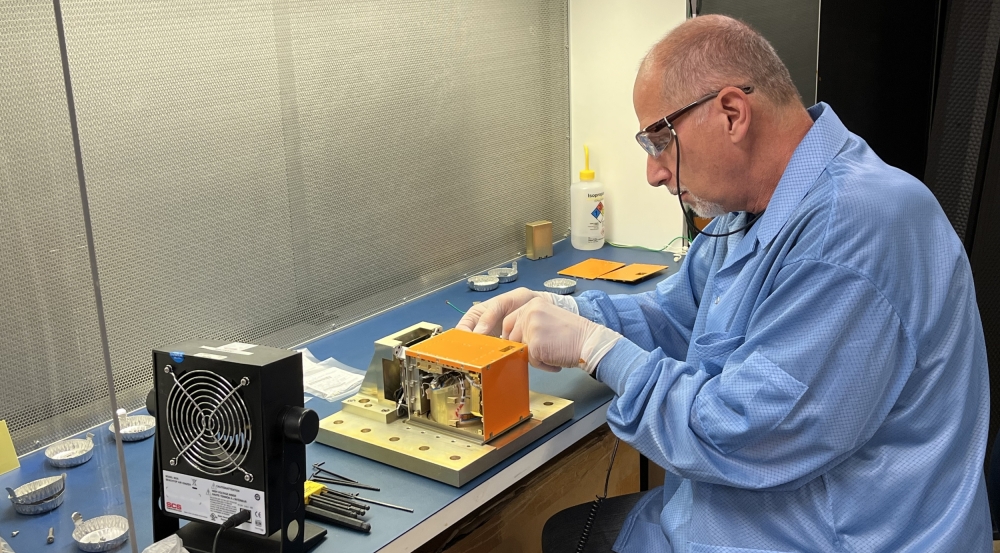
Keith Gaucher installs a Tomorrow.io microwave sounder payload onto an alignment fixture. Final assembly is completed on a fixture emulating the launch mounting configuration to ensure the payload launches in a state of minimal stress.
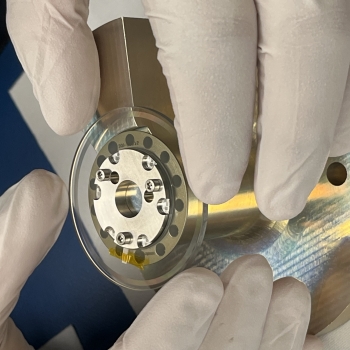
Buried deep in the rotating portion of the payload is an optical encoder. A laser reads a reflective signal off of a precision pattern around the outer diameter of the glass disc shown here.
Through years of iterative prototyping, our researchers and engineers developed and ruggedized a miniature microwave sounder. The resulting sensor is 100 times smaller than a traditional sounder at just 2% of the cost, making it ideal for low-cost CubeSat constellations. By distributing sounder functionality across multiple smaller satellites, constellations enhance forecasting through higher revisit rates over rapidly intensifying storms and mitigate mission risks from single-satellite failures. Our vertically integrated engineering facility enabled in-house design, analysis, machining, assembly, and testing of the miniaturized payload, ensuring the success of the TROPICS mission.
A commercial company, Tomorrow.io, has since licensed the microwave sounder technology. Transitioning our expertise to industry required engineer-to-engineer training and technician-to-technician interactions to transfer the nuances of a vertically integrated prototyping facility to a team of multiple industry vendors. Tomorrow.io has completed its fully operational constellation and will continue to replenish the constellation of more than 20 sounder-equipped CubeSats by 2028. Tomorrow.io will continue to improve weather forecasts for global customers, including the U.S. government.
Digital engineering streamlines development
As part of our Laboratory-wide digital transformation initiative, we are leveraging digital engineering tools to streamline design and development processes. During the development of a test bed aircraft, digital engineering tools and augmented reality (AR) headsets enabled immersive design reviews. Representatives from the sponsor organization toured an AR model of the aircraft, providing real-time feedback on equipment placement and human factors considerations. This process eliminated the need for design change orders, accelerating development timelines.
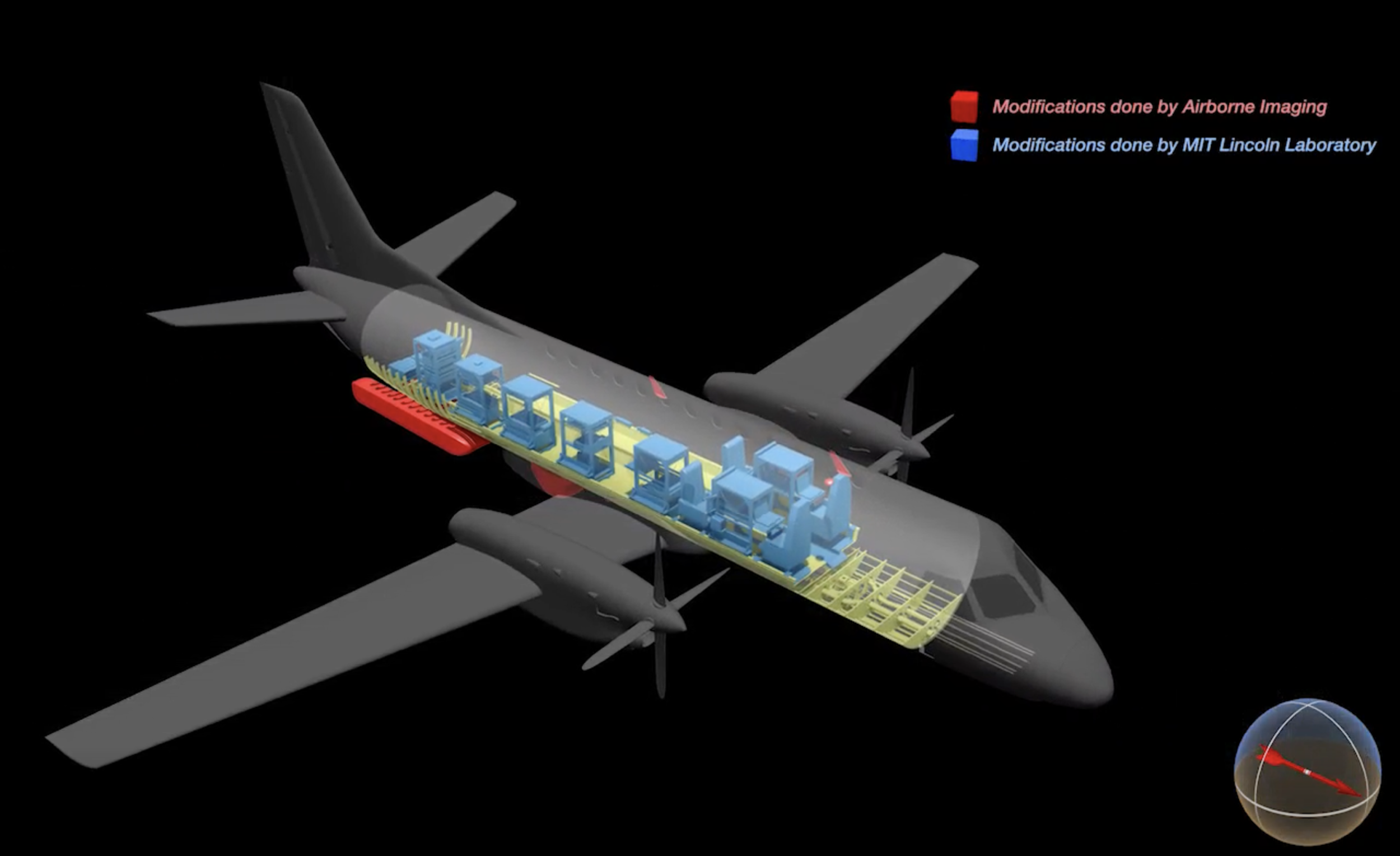
Digital engineering tools allow researchers to use virtual 3D models for simulating modifications to test beds, such as the Lincoln Laboratory Airborne Radar Testbed hosted on a Saab 340B aircraft.
Building on the success of the test bed's design phase, we used our latest investments in product lifecycle management tools to track equipment and software configurations from each test event. These capabilities are further accelerating development processes and providing agile flight services while maintaining compliance with FAA rules and regulations.


