


Each year, the Lincoln Laboratory Military Fellows Program awards fellowships to active-duty military officers who are enrolled in a graduate school program in the Boston area or who are completing requirements for advanced education at senior service schools. The program seeks to support the education of service members while involving them in R&D that addresses critical technology needs of the military. Since 2011, more than 500 military fellows have worked at the Laboratory, and in 2025 we welcomed an additional 23 fellows. A few of their research projects from this year are highlighted below.
Securing AI systems against cyberattacks
The U.S. Army has been increasingly using AI systems for intelligence and command and control operations, but these systems can be vulnerable to adversary interference. Army Col. and military fellow Ian Fleischmann conducts research on counter-AI, or how AI for defense systems can be made more resilient against attacks.
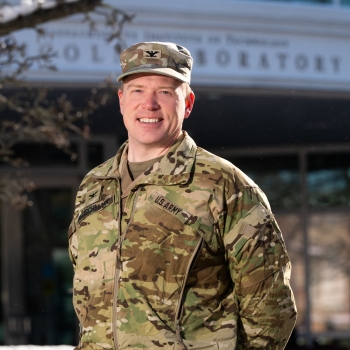
Military fellow Ian Fleischmann researches ways in which the Army can better protect its AI systems against cyberattacks.
"My research is focused on how the Army will need to adapt organizations and policies to effectively implement the counter-AI protocols required by emerging threats," Fleischmann says. He alternates between taking courses in the MIT Security Studies Program and coming to the Laboratory to review literature, interview staff, and attend technical seminars that could aid his research.
"Inspiration comes in lots of ways, and some of the most thought-provoking ideas I’ve encountered have come from attending seminars at the Laboratory that I otherwise would have never had the opportunity to hear," Fleischmann says. "There are a ton of projects here that would be hugely beneficial to the Army. Someday, I'd love to convince the Army to send me back to the Laboratory as a liaison to help connect teams to potential sponsors."
Communicating in extreme environments
The military, civilian, and scientific communities in the Arctic rely on information from satellite systems for many functions. But the harsh Arctic conditions present challenges for properly receiving, interpreting, and protecting this information. As a military fellow, U.S. Space Force 2d Lt. Kelsey "Zippy" Monaghan-Bergson is studying how approaches for U.S. space systems defense can better account for the unique challenges of operations in the Arctic — in particular, the need to safeguard orbital veracity, or the reliability and integrity of information produced or transmitted by space-based systems. On a micro level, Monaghan-Bergson seeks to understand how narrative choices in a message impact perception, legitimacy, and decision-making under stress. The objective is to strengthen how the military communicates, counters adversarial narratives, and preserves informational advantage in contested environments.
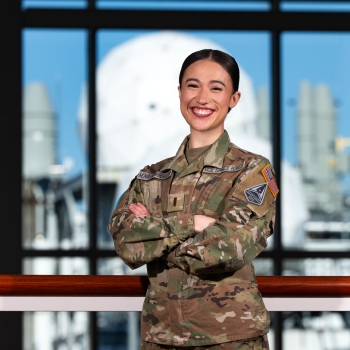
Military fellow Kelsey Monaghan-Bergson works alongside Laboratory staff to analyze information operations in the Arctic.
"The goal is to design systems that adapt to human communication patterns, helping Space Force operators process information quickly, avoid misinterpretation, and make clear, confident decisions in uncertain or contested information environments," Monaghan-Bergson says.
Working at the Laboratory reinforced for Monaghan-Bergson an important lesson: today's challenges cannot be solved by technology alone — they require human-centered approaches that consider ethics, culture, and the lived realities of the people these systems ultimately affect.
"This fellowship has been a testament to the inseparable bond between STEM and the humanities and social sciences. Too often, we frame them as opposites, when, in reality, they are codependent forces shaping how we understand, design, and defend our world," she says.
AI for the Air Force
The AI Accelerator is a three-way collaboration between Lincoln Laboratory, MIT, and the Department of the Air Force to make fundamental advances in AI for defense.
Autonomy for rescue missions
One project is developing algorithms for autonomous vehicles to support personnel recovery missions in conflict and disaster zones. The envisioned fleet will locate distressed individuals and provide rescuers with real-time data analysis for safe recovery. The project team earned the 2025 AI Accelerator Directors' Award for its exceptional collaboration with the Air Force Special Operations Command.
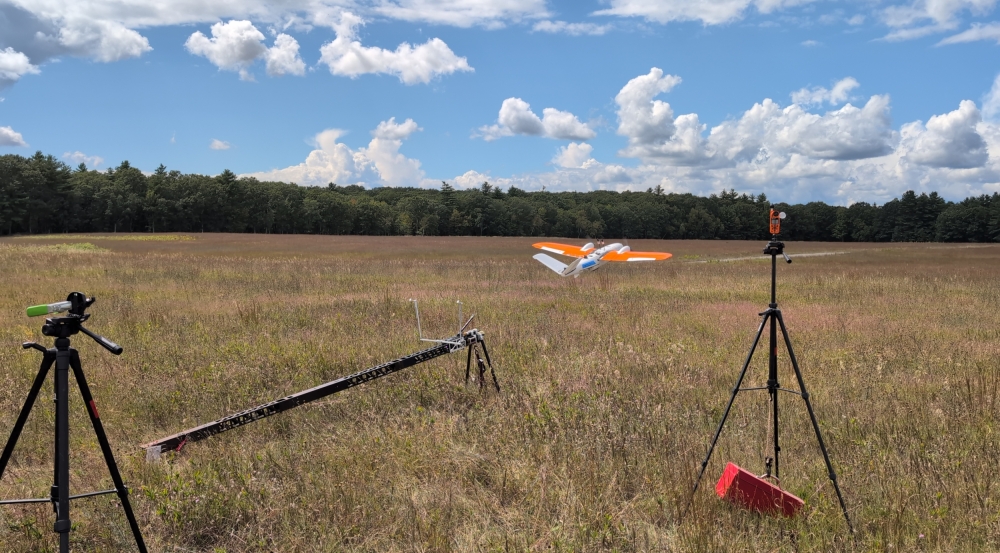
At the Devens Reserve Forces Training Area in Lancaster, Massachusetts, researchers collect flight data from a small autonomous aircraft. Photo: Major Stephanie Riley, U.S. Air Force
Techniques to secure networks
Another project is combatting cyberattacks through innovations in network sensing and analysis. Capabilities have been adopted by leading AI companies such as Nvidia, integrated into the U.S. Cyber Command's cyber training environment, and used by the Air Force to uncover massive spoofing capabilities. In addition, the team's AI policy analyses have influenced government policy, Air Force doctrine, and global copyright practices. For these achievements, the team received the 2025 AI Accelerator Transition Award.
The close collaboration between Airmen and Guardians; the faculty, researchers, and students at MIT; and MIT Lincoln Laboratory continues to pay dividends for national security.
Col. Scott Ruppel
Department of the Air Force director of the AI Accelerator
Solutions for SOCOM
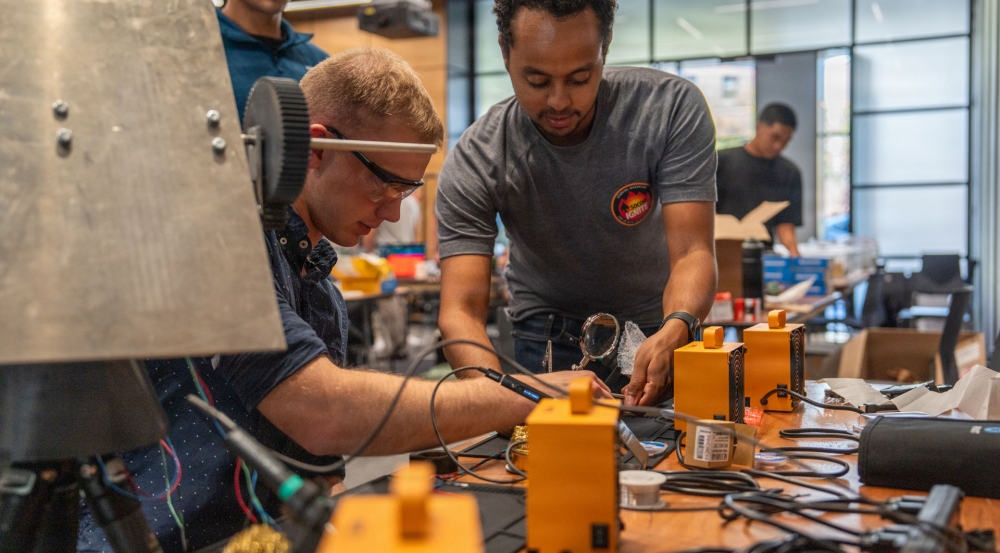
Cadets work alongside Lincoln Laboratory technical staff during the 2025–2026 SOCOM Ignite kickoff event on MIT campus in September 2025. Photo: Staff Sgt. Lawrence Wong, U.S. Army
Launched in collaboration with the Special Operations Command's Acquisition, Technology, and Logistics (SOCOM AT&L) directorate, the SOCOM Ignite program addresses challenges facing warfighters while fostering ingenuity in future military leaders. Starting in 2020 with just eight Reserve Officers Training Corps cadets, the program has now grown to host more than 100 cadets annually from universities and service academies across the country. These cadets collaborate year-round with Lincoln Laboratory technical mentors and Special Operations Forces operators to develop technology solutions, ranging from an autonomous surface vessel kit to a LEO satellite tracker. For the first time in 2025, all joint components of SOCOM participated in the program.
Training future leaders of the Space Force
We partner extensively with the U.S. Space Force to develop the next generation of technology-savvy Guardians. The Space Force sends approximately 50 students to Lincoln Laboratory each year to participate in educational opportunities.
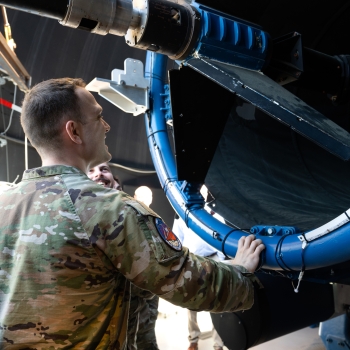
U.S. Air Force Test Pilot School students tour the Firepond telescope as part of their trip to the Lincoln Space Surveillance Complex.
Graduate Degree Programs
Through Lincoln Laboratory's Military Fellows program, the Space Force funds Guardians to study at MIT for an advanced academic degree. We offer co-advisors and research opportunities to each student in the program. To date, nearly 50 advanced degrees have been awarded to Space Force graduates.
Space Technology Acquisition and Research Course
Lincoln Laboratory has hosted a military Training and Education Detachment on site since 2016. Each year, the detachment hosts four 30-day courses for competitively selected Guardians who visit the Laboratory to learn about space security. The objective is for students to understand the use of advanced technology for their missions and return to the Space Force with ideas for how technology can shape future operations.
Space Test Course
As part of the Air Force Test Pilot School's Space Test Course, students visit Lincoln Laboratory to learn about effective space testing through briefings, a tour of the Lincoln Space Surveillance Complex, and hands-on exercises. For example, the students plan and execute radar collections, analyze test data, and mitigate electromagnetic interference.
Our visit to Lincoln Laboratory was by far the best learning experience in the Space Test Course. I appreciated being able to truly focus on executing a test — going from theory to simulation, working from hardware-in-the-loop testing, and then progressing to live testing.
Test Pilot School student
MIT research highlights
A new telescope for the cosmos
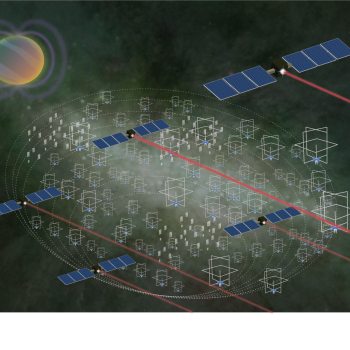
The Go-LoW telescope's approach uses a constellation of small satellites to study objects in space that emit low-frequency radio waves. Illustration: Nancy Kotary, MIT Haystack Observatory
In collaboration with the MIT Haystack Observatory and Lowell Observatory, we are designing a telescope comprising thousands of tiny satellites that will work together to reveal low-frequency radio waves in space for the first time. Called the Great Observatory for Long Wavelengths (GO-LoW), the satellite constellation will yield detailed data about exoplanets in the solar neighborhood. The NASA-funded concept study is one example of Lincoln Laboratory technology finding dual use for civil space missions. "Like landing on the Moon in 1969 or launching Hubble in 1990, GO-LoW is envisioned to let us see something we've never seen before," says Laboratory scientist Kat Kononov.
Practical quantum applications

Researchers demonstrated extremely strong nonlinear light-matter coupling in a quantum circuit. Stronger coupling enables faster readout and operations using qubits, which are the fundamental units of information in quantum computing.
We are participating in a new MIT initiative aimed at advancing the most significant practical applications of quantum technology for science, industry, and national security. Called QMIT, the initiative is a natural expansion of the Center for Quantum Engineering, a research powerhouse that engages more than 80 principal investigators across Lincoln Laboratory and MIT. One collaborative project in 2025 achieved a significant breakthrough toward building a fault-tolerant quantum computer. Researchers achieved a type of coupling between artificial atoms and photons that could enable readout and processing of quantum information in a few nanoseconds.


