


Homeland Protection
The defense of military bases beyond U.S. borders is crucial for protecting our troops, projecting power, and supporting allies. To enhance base protection, the U.S. Air Force has increased its focus on integrated defense — cohesively networking sensors, command and control systems, and physical security measures.
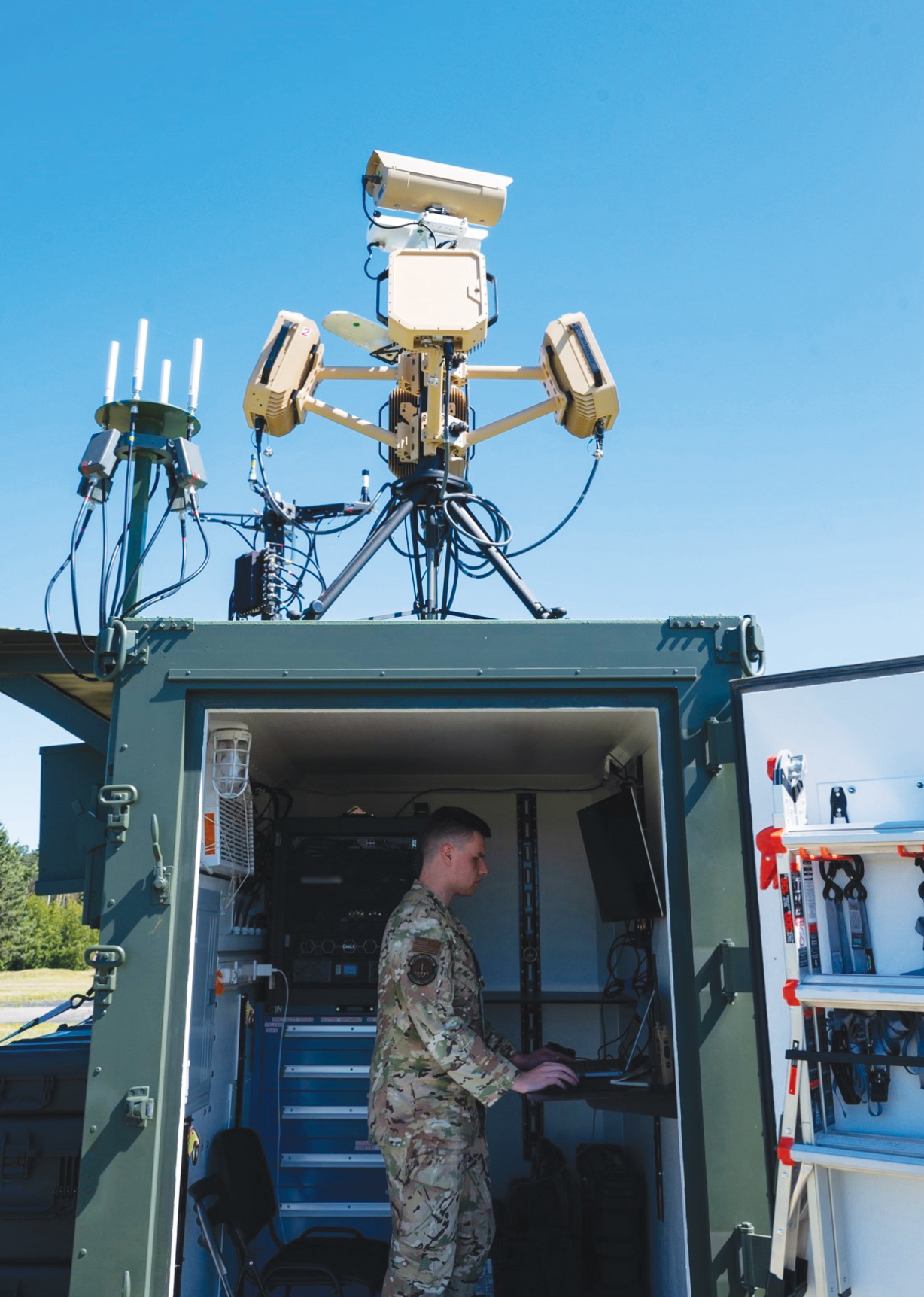
A U.S. airman operates a surveillance system at Ramstein Air Base. Photo: Staff Sgt. Gaspar Cortez
In support of this initiative, Lincoln Laboratory evaluated integrated air defense at Ramstein Air Base in Germany, the headquarters for the U.S. Air Forces in Europe — Air Forces Africa and NATO Allied Air Command. This evaluation led us to establish the Ramstein Air Defense System Integration Laboratory (RADSIL) in 2021.
An engineering and prototyping facility, RADSIL acts as a crucial hub for developing, evaluating, and integrating advanced technologies to enhance air defense against modern threats. Through RADSIL, we worked with industry partners to mature and transition air surveillance capabilities into operations, resulting in Europe's first multinational tactical air defense early-warning capability (EWC).
With EWC deployed in 2025, RADSIL continues to support pivotal assessments of decision support tools and advanced sensors for integration into the base's common operating picture, helping operators manage tracks of interest in the complex airspace over Europe.
Air, Missile, & Maritime Defense Technology
Missile threat analysis and modeling drives life-saving defense system improvements
Adversaries have demonstrated unprecedented use of ballistic missiles across the globe, including in the Middle East, where Iran and Houthi rebels launch near-daily attacks against U.S. warfighters and allies. Lincoln Laboratory developed advanced software that ingests and processes massive volumes of diverse sensor data to characterize hundreds of missile threats and assess the impact of these threats on operational defense system performance. This timely analysis has provided rapid feedback to deployed warfighters and improved intelligence assessments of threat capabilities.
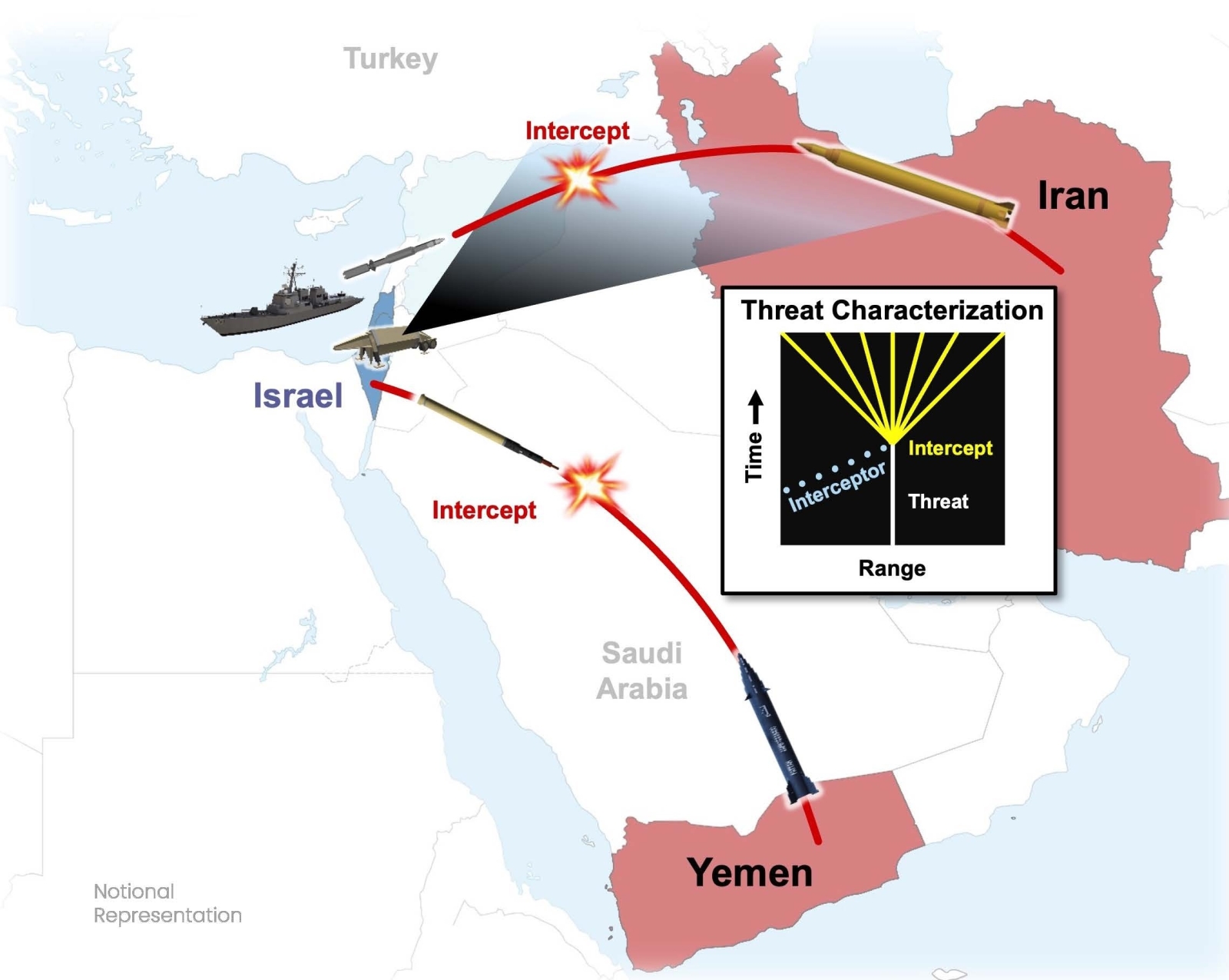
Lincoln Laboratory's missile threat characterization software is supporting operational and intelligence assessments in the Middle East.
We also leveraged the missile threat data to develop a physics-constrained framework for modeling missile radar signatures, capturing the broad range of potential threat configurations. Transitioned to the Missile Defense Agency and industry partners, this software package enables users to generate large sets of signatures to train and test AI and machine learning algorithms for object classification under fast-evolving decision timelines. The resulting algorithms will enhance the robustness of defense systems, ultimately saving lives.
The Lincoln Laboratory team has critically provided efficient target-signature data analysis and strategic-level kill assessment, which are often unachievable locally at the unit level.
Ret. LCDR Russell Allen
U.S. Navy
Tactical Systems
Rapidly deployable counter-drone technology keeps the nation safe
As the use of drones for military and civilian purposes continues to rise globally, so too does the necessity for counter-drone technologies to detect and intercept malicious activity. In particular, low-cost surveillance and one-way-attack drones pose a significant threat because adversaries can produce and deploy them at a rate that exceeds the production and employment capabilities of counter-drone systems. To defend against these types of threats, we developed a reusable, low-cost, and easily manufactured interceptor called Small Interceptor, Counter-Air (SICA).
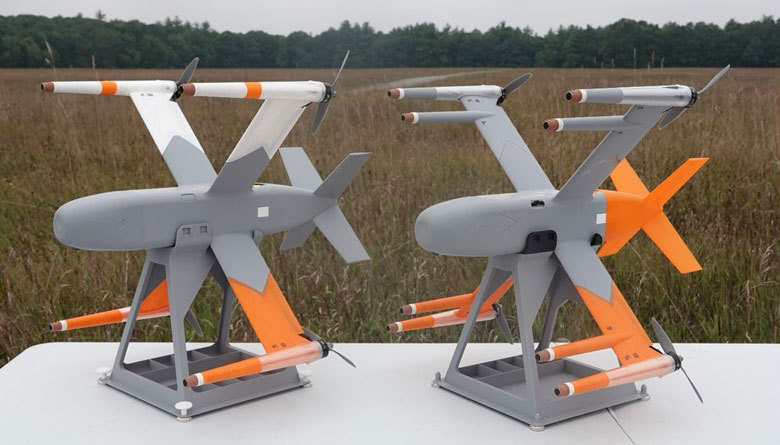
Two SICA systems are shown here prior to flight testing. Their 3D-printed X-wing system is 21 x 22 inches, weighs 6 pounds, and can carry an 800-gram payload that may include cameras or other sensors.
SICAs are assembled using commercial off-the-shelf parts and readily available tools such as a 3D printer, a screwdriver, glue, and a soldering gun. The interceptor body weighs about 6 pounds, has a top speed of 200 miles per hour, a maximum range of 40 km, and supports an instantaneous G-force limit of 12 Gs. The cost of building a SICA is 10 times less than that of current alternatives, and it can be assembled in less than two hours.
Our expertise in rapid prototyping enabled us to develop SICA and demonstrate it to government stakeholders at the OUSW (R&E) Technology Readiness Experimentation exercise in one year. The initial prototype is now evolving to encompass multiple variants with different capabilities.


