


Craig Rowe soars to new heights
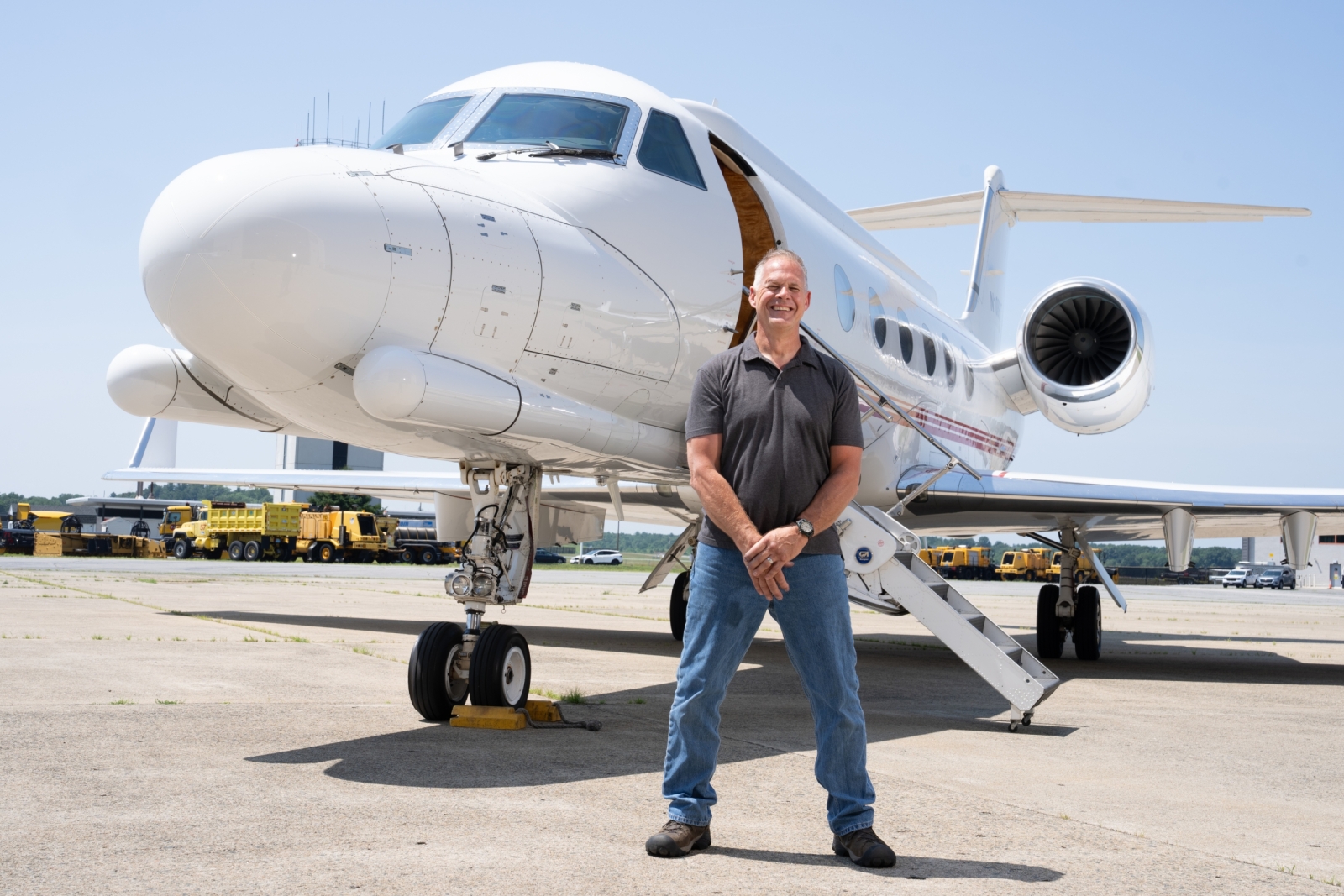
Working on airplanes is a profession that runs in the Rowe family. Craig Rowe, his twin brother, and older brother are all aircraft mechanics. His father was an aircraft technician installing systems on military aircraft during the Vietnam War after serving with the U.S. Navy in the Korean conflict.
"We are mechanically inclined," says Rowe, who since 2015 has been the lead crew chief of the Gulfstream IV, part of the aircraft fleet at MIT Lincoln Laboratory's Flight Test Facility on Hanscom Air Force Base. As lead crew chief, he manages the inspection, maintenance, and servicing of the aircraft to ensure it is fully operational and safe for flight. "Since I was a kid, I've had an interest in building and getting things running. I've also always been interested in airplanes, but this job involves more than just working on airplanes. These aircraft are test beds for the U.S. Department of War," Rowe says.
A career takes flight
Rowe began his career in 1985 as an automotive mechanic. From 1986 to 1988, he completed a certification program at Hanscom to obtain his airframe and powerplant license. Issued by the Federal Aviation Administration (FAA), this license authorizes individuals to inspect, maintain, and repair aircraft. Around that time, the major historic American carrier Eastern Air Lines went out of business, flooding the job market with aircraft mechanics and thereby complicating Rowe's search for an airline job. After two years in general aviation, Rowe returned to the automotive world until 1999, when he joined United Airlines operating out of Boston. For nearly a decade, he worked side by side with his twin, maintaining mostly wide-body aircraft. In 2008, a position opened at the Flight Test Facility for a mechanic to support a Boeing 707 – the same position held for 25 years by Rowe's older brother, who was moving onto another opportunity to work on government aircraft. That aircraft, like all at the facility, had been modified from its original manufactured state to support development and testing of airborne systems for the U.S. government.
"My previous experience in the automotive and aviation fields helped me get the job, which not only required maintaining the aircraft itself but also up to 30 pieces of ground support equipment in the hangar, from tractors and AC units to power systems," Rowe says.
Within six months of being hired, Rowe was promoted to senior mechanic. By 2010, he was overseeing a Falcon 20 jet that had hosted the Airborne Sensor Testbed (ASTB), used by the Laboratory's Tactical Defense Systems Group to assess and mitigate threats to U.S. Air Force aircraft. Rowe served as lead crew chief of the Falcon 20, which largely served as a "chase" plane (flying alongside other test aircraft to observe their operation), for five years. In 2015, the Laboratory purchased a Gulfstream IV (G-IV) to replace the Gulfstream II, which was the second platform to host the ASTB and was decommissioned in 2023 after 30 years in service.
"The G-IV is the first Gulfstream to digitally display critical flight data," Rowe says. "It's a far cry from the analog steam gauges of the Boeing 707. The newer technology of the G-IV is more in line with what I was trained on while working for the airlines. Even though the G-IV was built in 1999, that's not old by aircraft standards. These aircraft will fly 30, 40, 50 years as long as you maintain them properly."
Crews cross the border
When the G-IV arrived at the Flight Test Facility, the team there, led by engineers from the Tactical Defense Systems Group, began developing the engineering plans to modify the G-IV into a test bed. Meanwhile, the Laboratory's Contracting Services Department started searching for a contractor to design, manufacture, and install the modifications. They selected Field Aviation, whom the Laboratory had been contracting with since the early 1990s for aircraft modifications, including those on the Boeing, two Falcons, and the G-II.
After FTF mechanics stripped the aircraft's interior —leather seating, kitchen cabinetry, and other luxury features — the G-IV headed to Field Aviation's 40,000-square-foot hangar at Toronto Pearson International Airport in Canada in December 2018. Field Aviation technicians stripped the cockpit and removed electronics racks and external fairings (structures that make the plane aerodynamically favorable) so they could visualize the aircraft shell. After scanning the exposed aircraft structure, staff from the Tactical Defense Systems Group along with Rowe and other FTF subject-matter experts worked closely with Field Aviation engineers through preliminary and critical design reviews to verify that the proposed structural, aerodynamic, and electrical system changes would allow the aircraft to operate as required by the Air Force and FAA. These changes included installing load-bearing pylons under the wings, external mounts for sensors, and antenna farms on the roof and belly — all powered by a commercial-scale auxiliary power unit enclosed in a custom-built fireproof titanium box for flight.
Taking turns with his Tactical Defense Systems Group program manager, Rowe flew up monthly to Canada to oversee the disassembly, modification, and ongoing maintenance of the aircraft. At the end of 2019, Rowe and two other mechanics boarded the 45-minute flight to Toronto to remove the two engines from the G-IV and load them onto tractor-trailer trucks bound for engine manufacturer Rolls-Royce in Montreal.
"Engine parts can degrade over time, so they undergo calendar-based inspection and maintenance to ensure they can still safely power flight," Rowe explains. "The G-IV was due for its 20-year engine overhaul, which took three months for both motors."
When Rowe and his team reinstalled the overhauled engines on March 20, 2020, little did they know that a pandemic was about to cause a worldwide shutdown. They left Canada with six hours to spare before the border closed. A work stalemate ensued until early fall, when they were permitted to return to Canada. The modifications continued through 2023, when Field Aviation started reassembling the aircraft, assisted by Rowe and two or three mechanics on each trip.
"The engines had sat idle on the airplane for well over five years because we had no cockpit to start them," Rowe says. "We had to rebuild the cockpit from scratch from a yoke [control wheel] and hanging wires. Everything down to the frame, including all radio racks, was gone. When you fly the aircraft for the first time after 2,200 parts were put back on, you pray you did it right. The reassembled aircraft not only powered on but also took its first flight without a hiccup, which is a testament to the team's work. When the pilots and flight-test engineer returned, they gave me a big hug. I was very emotional."
An asset comes home
In April, the G-IV returned to the Flight Facility, after nearly seven and a half years. Rowe had taken 80 roundtrip flights to Toronto, with stays spanning two to three weeks at a time. Sometimes, he stayed straight through weekends without returning home to his wife and two sons, who were in elementary school when the G-IV was brought to Canada and in high school when it returned to the Laboratory. Rowe missed many weeknights of homework help and holidays.
For his leadership role in the G-IV modification effort, Rowe was recognized with a 2026 MIT Excellence Award in the Outstanding Contributor: Working Behind the Scenes category.
"Craig is a humble, confident, and approachable 'rockstar' aircraft mechanic. His commitment to the G-IV modification program largely contributed to its success and will leave a lasting impact as the aircraft returns to service on behalf of the Air Force," says David Culbertson, manager of the Flight Test Facility.
Rowe's work behind the scenes continues with supporting flight testing to validate the safety and functionality of the G-IV before the Tactical Defense Systems Group begins running Air Force–sponsored programs. This airworthiness testing involves test pilots flying the plane in military-designated no-traffic areas (usually over the ocean) to evaluate aircraft performance and handling qualities to ensure FAA standards are met. The first step is calibrating instrumentation readings at different altitudes. As Rowe explains, the structural additions to the G-IV changed the airflow over its airframe, where ports sense air pressure, temperature, and angle of attack (angle between the aircraft's wing and oncoming wind) — measurements used to calculate critical flight parameters like altitude and air speed. A truth source for calibrating cockpit readouts can be established by placing a nose boom (an extension projecting from the aircraft's nose) housing sensors in front of the plane to measure unperturbed airflow. Those sensor outputs are sent to a separate screen mounted in the cockpit, enabling comparisons with the baseline aircraft instrument readings on the cockpit displays.
Hundreds of hours of computational fluid dynamics analysis by the Laboratory’s Engineering Division at the Lincoln Laboratory Supercomputing Center to refine the aerodynamic designs of the modifications paid off when the cockpit displays matched nose-boom truth measurements almost exactly. Test pilots are also conducting in-flight vibration and flutter testing with accelerometers mounted throughout the airframe and control surfaces. These sensors track how the airframe structurally responds to aerodynamic forces; aircraft parts can crack, bend, or, in extreme cases, catastrophically fail if they vibrate at their natural frequency.
"The smallest detail can derail a carefully planned flight test, especially on an aircraft as heavily modified as this G-IV," says G-IV modification program manager Paul Mancini of the Tactical Defense Systems Group. "I spend a lot of my time thinking about what can go wrong and how to mitigate it. But with Craig as the crew chief, backed by the rest of the Flight Test Facility, the one thing I don’t worry about is having a good jet ready to go when we need it."
The G-IV is expected to be mission qualified to operationally support the Air Force by 2027. "Our next step is getting the G-IV working for the government like it's supposed to," Rowe says. "I plan to retire in about six years, at which time the G-IV will be handed over to someone else to take care of for the next 20 years. This transition will be bittersweet; you get attached to your airplane like you do to a house or car."
Inquiries: contact Ariana Gaines.
Related Links