


Emma McDaniel
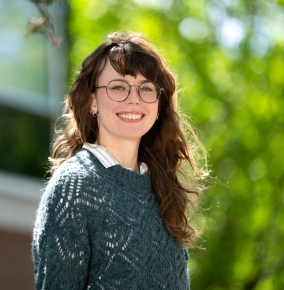
What do you do at the Laboratory?
A lot of my work focuses on large language models, specifically, building infrastructure and harnesses around them to enable their application across different operational contexts. I also work in the geospatial data science and computer vision domain, developing pipelines that transform data into actionable information.
From day to day, this work involves figuring out the problem space and what is needed and then determining how to deliver that information effectively. I work with domain and subject matter experts (who know far more about the subject than I do) to synthesize all that expertise and build applied research products that solve real problems.
What are you working on now?
The project I'm most excited about is the Machine Learning-Hydrodynamic Driven Rapid Assessment of Storms (ML-HYDRAS), where our team is developing a machine-learning model for real-time hydrological mapping. The model aims to simulate possible water depth and water flow given a region to support decision-making during flood events.
Not only do I think the mission of the project is important, but I also think the team I'm working with is phenomenal and incredibly talented. I love having the opportunity to learn from them while applying my existing knowledge.
What inspired you to pursue the path you chose?
For most of my life, I've wanted to do something that makes a difference. After finishing my undergrad and teaching English for a year, I became interested in the work being done at Armin Mikler's Center for Computational Epidemiology and Response Analysis at the University of North Texas, where they were building decision-support tools for emergency managers to respond to public health emergencies. Inspired by the mission and work, I decided to pursue a PhD in computer science because of the impact that I felt the technical skills I could learn would do.
When Mikler, my PhD advisor, moved to Georgia State University, I came along and became a founding member of Chetan Tiwari’s Center for Disaster Informatics and Computational Epidemiology. There, I developed expertise in geospatial data science — skills that have become foundational to my current work at the Laboratory.
What are some of your hobbies?
My undergraduate degree was in English literature and I'm an avid reader. Most of the books I love are dystopian in nature; I find it fascinating to see worlds where things have gone wrong. I think it provides me with a mental catalog of failure modes, which helps me think about how to avoid those outcomes in both my personal and professional life.