CrisisChat
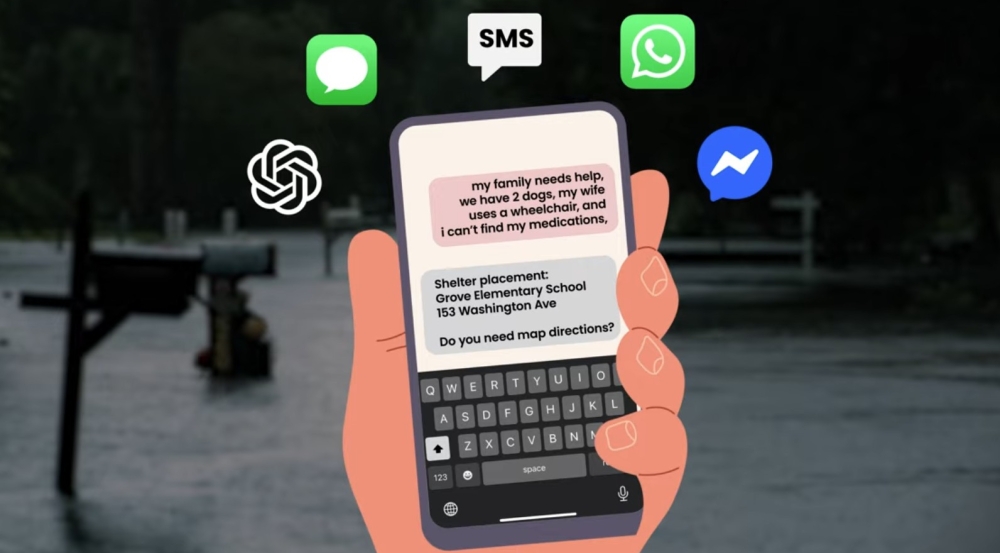
A collaboration between researchers at MIT Lincoln Laboratory's Human Resilience Technology Group and at MIT campus from the Laboratory for Information and Decision Systems (LIDS), Operations Research Center (ORC), Department of Civil and Environmental Engineering (CEE), and Department of Earth, Atmospheric and Planetary Sciences (EAPS) has developed CrisisChat, a generative AI chatbot designed to provide trustworthy, personalized information during disasters. CrisisChat is designed to support multiple emergency communication needs, and the initial chatbot prototype works to address a fundamental challenge in disaster response, where the decisions of those seeking shelter, often made independently, affect available shelter capacity for everyone. Existing shelter finder tools and apps typically direct individuals to the nearest available shelters without accounting for system-wide demand or individual circumstances.
CrisisChat uses an optimization framework that accounts for unobserved population behavior and incorporates flood prediction data and demographic information to estimate where people will go. The system then routes chatbot users to shelters that balance immediate travel distance against anticipated future crowding across the entire network. This approach treats shelter allocation as a coordination problem across the entire system rather than simply directing individuals to the nearest available shelter.
"There is a well-known problem of a lack of trusted and reliable bidirectional communication from emergency managers or the government at large," says Emma McDaniel, the CrisisChat project team lead from the Laboratory’s Human Resilience Technology Group. "Providing this direct connection gives affected individuals and their families the best information that they can get, starting with optimized shelter recommendations during floods."
CrisisChat's generative AI component also allows users to input natural language queries and receive a personalized and relevant response. Many existing emergency management chatbots, both prototypes and deployed systems, rely on dropdown menus or provide "canned" responses to user input based on key terms. With CrisisChat, a natural language query would result in contextually relevant, personalized guidance. With further development, the system could enable bidirectional communication, allowing users' messages to be validated and escalated to emergency managers with real-time information about conditions such as impassable roads or flooding extent, and supported by photos and other documentation. Validation mechanisms would help ensure information authenticity and reliability.
The research team is now seeking follow-on funding and collaborators to further develop CrisisChat's features, including expanded bidirectional communication capabilities, and to advance the system to meet user and operational needs.
For more information, or to collaborate with the CrisisChat team, contact Emma McDaniel.
Additional information:
CrisisChat was funded by MIT’s Generative AI Impact Consortium. LIDS, CEE, and ORC designed the system architecture and developed predictive models for demand estimation and stochastic optimization models for population-wide shelter allocation under uncertain demand. EAPS provided high-resolution flood inundation prediction maps across multiple flooding events to inform the demand estimation models. Lincoln Laboratory's Human Resilience Technology Group contributed expertise in applied large language models, disaster response domain knowledge, and the development of the user-facing chatbot prototype that wraps the optimization models in an agentic framework to respond.
- Saurabh Amin, CrisisChat MIT principal investigator, LIDS and CEE
- Sai Ravela, CrisisChat co-principal investigator, EAPS
- Emma McDaniel, CrisisChat Lincoln Laboratory principal investigator, Human Resilience Technology Group
- Georgia Perakis, faculty collaborator, Sloan School of Management
- Jeffrey Liu, collaborator, Human Resilience Technology Group
- Jenny Rowlett, collaborator, Human Resilience Technology Group
- William Zhang, PhD student, ORC
- Maxime Bouscary, PhD student, ORC
- Rohit Parasnis, Postdoc, LIDS
Related
News

A flexible robot can help emergency responders search through rubble

An AI dataset carves new paths to tornado detection